
Mailbox Monday Treasures
BurtonReview
Sunday, May 02, 2010
 Mailbox Monday is a weekly meme that is hosted by Marcia at The Printed Page. We share what books that we found in our mailboxes last week. And I am adding what I purchased, swapped, etc.
Warning:
Exploring Mailbox Mondays across the blogosphere will lead to toppling wishlists and to-be-read-piles! But it's the thrill of the chase that counts!
This is a little long because I didn't do a Mailbox Monday last weekm instead I read close to three books!
And it always helps to have a friend who likes to give away books. She is entirely truely generously awesome. Thank you! She sent me books that have been languishing on my wishlist and almost forgotten about:
 Jane Boleyn by Julia Fox (PERFECT for the Tudor Mania Challenge!)
In a life of extraordinary drama, Jane Boleyn was catapulted from the obscurity of the Essex countryside to the forefront of Henry VIII's spectacular court. Born Jane Rochford in about 1505, this daughter of an aristocratic family became lady in waiting to not just one, but five of Henry's wives. Always at the center of court life and intrigue, Jane attended the parties, the masque balls, and the jousts, and participated in the royal births, the weddings, funerals and personal drama that swirled around the King, his wives and courtiers. What makes Jane Boleyn so unique is that she was a survivor. As Henry's wives rose and then fell, taking so many down with them, Jane stayed on. Her story gives readers an amazing on-going view of the personal toll that Henry's long and ruthlessly violent reign took on the people closest to him.
 Doomed Queens by Kris Waldherr
Marie Antoinette, Anne Boleyn, and Mary, Queen of Scots. What did they have in common? For a while they were crowned in gold, cosseted in silk, and flattered by courtiers. But in the end, they spent long nights in dark prison towers and were marched to the scaffold where they surrendered their heads to the executioner. And they are hardly alone in their undignified demises. Throughout history, royal women have had a distressing way of meeting bad ends--dying of starvation, being burned at the stake, or expiring in childbirth while trying desperately to produce an heir. They always had to be on their toes and all too often even devious plotting, miraculous pregnancies, and selling out their sisters was not enough to keep them from forcible consignment to religious orders. From Cleopatra (suicide by asp), to Princess Caroline (suspiciously poisoned on her coronation day), there’s a gory downside to being blue-blooded when you lack a Y chromosome. Kris Waldherr’s elegant little book is a chronicle of the trials and tribulations of queens across the ages, a quirky, funny, utterly macabre tribute to the dark side of female empowerment. Over the course of fifty irresistibly illustrated and too-brief lives, Doomed Queens charts centuries of regal backstabbing and intrigue. We meet well-known figures like Catherine of Aragon, whose happy marriage to Henry VIII ended prematurely when it became clear that she was a starter wife--the first of six. And we meet forgotten queens like Amalasuntha, the notoriously literate Ostrogoth princess who overreached politically and was strangled in her bath.While their ends were bleak, these queens did not die without purpose. Their unfortunate lives are colorful cautionary tales for today’s would-be power brokers--a legacy of worldly and womanly wisdom gathered one spectacular regal ruin at a time.
The Sisters of Henry VIII by Maria Perry
A highly detailed history of intricate dynastic political tangles among England, Scotland, and their European neighbors during the 16th century. English actress, journalist, and historian Perry transports readers to a far-off time as she acquaints us with Henry VIII's lesser-known relatives. The author delves deeply into contemporary sources from an age when royal marriages played a dominant role in the art of politics. She captures the pageantry of power politics in a time when nobility competed with lavish displays of great wealth and conspicuous consumption that in itself suggested power and prestige among the royal houses of Europe. Margaret Tudor, Henry's elder sister, was widowed when James IV of Scotland died attacking the English at Flodden Field, a Scottish disaster. She later married a Douglas, Lord Angus, an enemy of the volatile Scottish ruling clans, causing herself much angst while fleeing danger with her two sons, potential heirs to the English throne. After a life of turmoil in near-anarchic Scotland, she is remembered as the grandmother of Mary Stuart, Queen of Scots, and great-grandmother of James VI of Scotland, who became James I of England. Mary Tudor, Henry's younger sister, married the aged Louis XII of France, became a widow shortly thereafter, then wed the duke of Suffolk, producing more pretenders to the throne. Henry's marriage to Anne Boleyn divided the country as many admired the devout, rejected Katharine of Aragon. Thankfully, the book includes a "House of Tudor" chart that will help general readers sort out the crowded cast of characters who shaped many of the leading events of the age. Perry's insightful account of the king's sisters and their timesmight well provide currently Tudor-infatuated Hollywood with a good source for future movies and miniseries.~Kirkus Reviews
 The First Princess of Wales by Karen Harper
The daughter of a disgraced earl, she matched wits with a prince.
It is the fourteenth century, the height of the Medieval Age, and at the court of King Edward III of England, chivalry is loudly praised while treachery runs rampant. When the lovely and high-spirited Joan of Kent is sent to this politically charged court, she is woefully unprepared for the underhanded maneuverings of her peers.
Determined to increase the breadth of his rule, the king will use any means necessary to gain control of France—including manipulating his own son, Edward, Prince of Wales. Joan plots to become involved with the prince to scandalize the royal family, for she has learned they engineered her father’s downfall and death. But what begins as a calculated strategy soon—to Joan’s surprise—grows into love. When Joan learns that Edward returns her feelings, she is soon fighting her own, for how can she love the man that ruined her family? And, if she does, what will be the cost?
Filled with scandal, court intrigue, and prominent figures of the Medieval Age, The First Princess of Wales has at its center a wonderful love story, which is all the more remarkable because it is true. Karen Harper’s compelling, fast-paced novel tells the riveting tale of an innocent girl who marries a prince and gives birth to a king.
 The Perfect Royal Mistress by Diane Haeger
Born into poverty and raised in a brothel, Nell Gwynne sells oranges in the pit at London’s King’s Theater, newly reopened after the plague and the Great Fire devastated the city. Soon, her quick sense of humor and natural charm get her noticed by those who have the means to make her life easier. But the street-smart Nell knows a woman doesn’t get ahead by selling her body. Through talent, charm, intelligence, and sheer determination—as well as a keen understanding of how the world operates—Nell works her way out of the pit and onto the stage to become the leading comedic actress of the day. Her skills and beauty quickly win the attention of all of London—eventually even catching the eye of King Charles II. Their attraction is as real as it is unlikely, and the scrappy orange girl with the pretty face and the quick wit soon finds herself plunged into the confusing and dangerous world of the court, where she learns there are few she can trust—and many whom she cannot turn her back on.
From the gritty streets of seventeenth-century London, to the backstage glamour of its theaters, to the glittering court of Charles II, The Perfect Royal Mistress is a love story for the ages, the rags-to-riches tale of a truly remarkable heroine.
And a goodie, a memoir by a faved childhood author Beverly Cleary: A Girl from Yamhill (Bev is 94 years young! Generations of children have grown up with Henry Huggins, Ramona Quimby, and all of their friends, families, and assorted pets. For everyone who has enjoyed the pranks and schemes, embarrassing moments, and all of the other poignant and colorful images of childhood brought to life in Beverly Cleary books, here is the fascinating true story of the remarkable woman who created them.
I ordered myself some goodies from The Book Depository in the UK, which was just in time since they are now out of the stock of them:
 The Sun in Splendour by Jean Plaidy
Reckoned by those about him to be the most handsome man in the country, Edward the fourth has risen to the throne with the help of Warwick, the kingmaker. But even Warwick's trusted advice cannot convince the King to ignore his passion for the beautiful widow, Elizabeth Woodville - and when she refuses to become his mistress the two are married.
 Lords of the White Castle by Elizabeth Chadwick
Based on a remarkable true story of honour, treachery and love spanning the turbulent reigns of four great Mediaeval kings. Award-winning author Elizabeth Chadwick brings the thirteenth century vividly to life in the tale of Fulke FitzWarin. From inexperienced young courtier to powerful Marcher lord, from loyal knight to dangerous outlaw, from lover of many women to faithful husband, Fulke's life story bursts across the page in authentic detail. A violent quarrel with Prince John, later King John, disrupts Fulke's life ambition to become 'Lord of the White Castle' and leads him to rebel. There are perils for John at every turn. No less dramatic is the dangerous love that Fulke harbours for Maude Walter, a wealthy widow whom John wants for himself. Negotiating a maze of deceit, treachery and shifting political alliances Fulke's striving is rewarded, but success is precarious. Personal tragedy follows the turbulence of the Magna Carta rebellion, culminating in the destruction of everything for which Fulke has fought. Yet even among the ashes he finds a reason to begin anew.
Paperbackswap:
 The Last Days of Henry VIII by Robert Hutchinson
blazing narrative history that boldly captures the end of England's most despotic ruler and his court -- a time of murderous conspiracies, terrifying betrayals, and sordid intrigue Henry VIII's crimes against his wives are well documented and have become historical lore. But much less attention has been paid to his monarchy, especially the closing years of his reign. Rich with information including details from new archival material and written with the nail-biting suspense of a modern thriller, "The Last Days of Henry VIII" offers a superb fresh look at this fascinating figure and new insight into an intriguing chapter in history. Robert Hutchinson paints a brilliant portrait of this egotistical tyrant who governed with a ruthlessness that rivals that of modern dictators; a monarch who had "no respect or fear of anyone in this world," according to the Spanish ambassador to his court. Henry VIII pioneered the modern "show trial": cynical propaganda exercises in which the victims were condemned before the proceedings even opened, proving the most powerful men in the land could be brought down overnight. After thirty-five years in power, Henry was a bloated, hideously obese, black-humored old recluse. And despite his having had six wives, the Tudor dynasty rested on the slight shoulders of his only male heir, the nine-year-old Prince Edward -- a situation that spurred rival factions into a deadly conflict to control the throne. "The Last Days of Henry VIII" is a gripping and compelling history as fascinating and remarkable as its subject.
For review:
Eleanor the Queen by Norah Lofts (a reissue)
Eleanor is young, high-spirited, supremely intelligent, heiress to the vast Duchy of Aquitaine - at a time when a woman's value was measured in terms of wealth. This is the story of a medieval figure - of a princess who led her own knights to the Crusades, who was bride to two kings and mother of Richard the Lion Heart.
 For The King by Catherine Delors (for the June Historical Fiction Bloggers Round Table event!)
The Reign of Terror has ended, and Napoléon Bonaparte has seized power, but shifting political loyalties still tear apart families and lovers. On Christmas Eve 1800, a bomb explodes along Bonaparte's route, narrowly missing him but striking dozens of bystanders. Chief Inspector Roch Miquel, a young policeman with a bright future and a beautiful mistress, must arrest the assassins before they attack again. Complicating Miquel's investigation are the maneuverings of his superior, the redoubtable Fouché, the indiscretions of his own father, a former Jacobin, and two intriguing women.
Based on real events and characters and rich with historical detail, For the King takes readers through the dark alleys and glittering salons of post-revolutionary Paris and is a timeless epic of love, betrayal, and redemption.
And a giveaway win:
Lady Susan, The Watsons and Sanditon by Jane Austen (the same Sanditon that Ic ouldn't finish because there were zero paragraph breaks or punctuation in my edition! This one will read just fine, thank you!)Penguin Classics edition
And the book that I have wanted forever but never could find it below $55.. so my husband bought it for me =)
Historical Fiction II: A Guide to the Genre (Genreflecting Advisory Series) ~ Sarah L. Johnson (Editor), a fellow blogger at Reading the Past

"Johnson has updated her outstanding Historical Fiction: A Guide to the Genre (2005) by covering historical fiction from 2004 through mid-2008 and adding such new features as ISBNs for each book and keyword descriptors after each annotation. Chapter introductions have been updated to reflect changes, and a section on historical-fiction blogs has been added to the chapter on resources. This volume continues rather than replaces the earlier work, adding more than 2,700 new titles. . . . Historical Fiction was an essential purchase for public and school libraries, and Historical Fiction II will also be a must purchase since it covers the latest books in this very popular genre." ~Booklist
I love how Sarah has the Chapters separated out.. I tried to take a pic with the iPhone but they came out yucky, I still wanted to show you though!

 Click the pics to enlarge them.
This is a little long because I didn't do a Mailbox Monday last weekm instead I read close to three books!
And it always helps to have a friend who likes to give away books. She is entirely truely generously awesome. Thank you! She sent me books that have been languishing on my wishlist and almost forgotten about:
In a life of extraordinary drama, Jane Boleyn was catapulted from the obscurity of the Essex countryside to the forefront of Henry VIII's spectacular court. Born Jane Rochford in about 1505, this daughter of an aristocratic family became lady in waiting to not just one, but five of Henry's wives. Always at the center of court life and intrigue, Jane attended the parties, the masque balls, and the jousts, and participated in the royal births, the weddings, funerals and personal drama that swirled around the King, his wives and courtiers. What makes Jane Boleyn so unique is that she was a survivor. As Henry's wives rose and then fell, taking so many down with them, Jane stayed on. Her story gives readers an amazing on-going view of the personal toll that Henry's long and ruthlessly violent reign took on the people closest to him.
Marie Antoinette, Anne Boleyn, and Mary, Queen of Scots. What did they have in common? For a while they were crowned in gold, cosseted in silk, and flattered by courtiers. But in the end, they spent long nights in dark prison towers and were marched to the scaffold where they surrendered their heads to the executioner. And they are hardly alone in their undignified demises. Throughout history, royal women have had a distressing way of meeting bad ends--dying of starvation, being burned at the stake, or expiring in childbirth while trying desperately to produce an heir. They always had to be on their toes and all too often even devious plotting, miraculous pregnancies, and selling out their sisters was not enough to keep them from forcible consignment to religious orders. From Cleopatra (suicide by asp), to Princess Caroline (suspiciously poisoned on her coronation day), there’s a gory downside to being blue-blooded when you lack a Y chromosome. Kris Waldherr’s elegant little book is a chronicle of the trials and tribulations of queens across the ages, a quirky, funny, utterly macabre tribute to the dark side of female empowerment. Over the course of fifty irresistibly illustrated and too-brief lives, Doomed Queens charts centuries of regal backstabbing and intrigue. We meet well-known figures like Catherine of Aragon, whose happy marriage to Henry VIII ended prematurely when it became clear that she was a starter wife--the first of six. And we meet forgotten queens like Amalasuntha, the notoriously literate Ostrogoth princess who overreached politically and was strangled in her bath.While their ends were bleak, these queens did not die without purpose. Their unfortunate lives are colorful cautionary tales for today’s would-be power brokers--a legacy of worldly and womanly wisdom gathered one spectacular regal ruin at a time.
The Sisters of Henry VIII by Maria Perry
A highly detailed history of intricate dynastic political tangles among England, Scotland, and their European neighbors during the 16th century. English actress, journalist, and historian Perry transports readers to a far-off time as she acquaints us with Henry VIII's lesser-known relatives. The author delves deeply into contemporary sources from an age when royal marriages played a dominant role in the art of politics. She captures the pageantry of power politics in a time when nobility competed with lavish displays of great wealth and conspicuous consumption that in itself suggested power and prestige among the royal houses of Europe. Margaret Tudor, Henry's elder sister, was widowed when James IV of Scotland died attacking the English at Flodden Field, a Scottish disaster. She later married a Douglas, Lord Angus, an enemy of the volatile Scottish ruling clans, causing herself much angst while fleeing danger with her two sons, potential heirs to the English throne. After a life of turmoil in near-anarchic Scotland, she is remembered as the grandmother of Mary Stuart, Queen of Scots, and great-grandmother of James VI of Scotland, who became James I of England. Mary Tudor, Henry's younger sister, married the aged Louis XII of France, became a widow shortly thereafter, then wed the duke of Suffolk, producing more pretenders to the throne. Henry's marriage to Anne Boleyn divided the country as many admired the devout, rejected Katharine of Aragon. Thankfully, the book includes a "House of Tudor" chart that will help general readers sort out the crowded cast of characters who shaped many of the leading events of the age. Perry's insightful account of the king's sisters and their timesmight well provide currently Tudor-infatuated Hollywood with a good source for future movies and miniseries.~Kirkus Reviews

The daughter of a disgraced earl, she matched wits with a prince.
It is the fourteenth century, the height of the Medieval Age, and at the court of King Edward III of England, chivalry is loudly praised while treachery runs rampant. When the lovely and high-spirited Joan of Kent is sent to this politically charged court, she is woefully unprepared for the underhanded maneuverings of her peers.
Determined to increase the breadth of his rule, the king will use any means necessary to gain control of France—including manipulating his own son, Edward, Prince of Wales. Joan plots to become involved with the prince to scandalize the royal family, for she has learned they engineered her father’s downfall and death. But what begins as a calculated strategy soon—to Joan’s surprise—grows into love. When Joan learns that Edward returns her feelings, she is soon fighting her own, for how can she love the man that ruined her family? And, if she does, what will be the cost?
Filled with scandal, court intrigue, and prominent figures of the Medieval Age, The First Princess of Wales has at its center a wonderful love story, which is all the more remarkable because it is true. Karen Harper’s compelling, fast-paced novel tells the riveting tale of an innocent girl who marries a prince and gives birth to a king.

Born into poverty and raised in a brothel, Nell Gwynne sells oranges in the pit at London’s King’s Theater, newly reopened after the plague and the Great Fire devastated the city. Soon, her quick sense of humor and natural charm get her noticed by those who have the means to make her life easier. But the street-smart Nell knows a woman doesn’t get ahead by selling her body. Through talent, charm, intelligence, and sheer determination—as well as a keen understanding of how the world operates—Nell works her way out of the pit and onto the stage to become the leading comedic actress of the day. Her skills and beauty quickly win the attention of all of London—eventually even catching the eye of King Charles II. Their attraction is as real as it is unlikely, and the scrappy orange girl with the pretty face and the quick wit soon finds herself plunged into the confusing and dangerous world of the court, where she learns there are few she can trust—and many whom she cannot turn her back on.
From the gritty streets of seventeenth-century London, to the backstage glamour of its theaters, to the glittering court of Charles II, The Perfect Royal Mistress is a love story for the ages, the rags-to-riches tale of a truly remarkable heroine.
And a goodie, a memoir by a faved childhood author Beverly Cleary: A Girl from Yamhill (Bev is 94 years young! Generations of children have grown up with Henry Huggins, Ramona Quimby, and all of their friends, families, and assorted pets. For everyone who has enjoyed the pranks and schemes, embarrassing moments, and all of the other poignant and colorful images of childhood brought to life in Beverly Cleary books, here is the fascinating true story of the remarkable woman who created them.
I ordered myself some goodies from The Book Depository in the UK, which was just in time since they are now out of the stock of them:

Reckoned by those about him to be the most handsome man in the country, Edward the fourth has risen to the throne with the help of Warwick, the kingmaker. But even Warwick's trusted advice cannot convince the King to ignore his passion for the beautiful widow, Elizabeth Woodville - and when she refuses to become his mistress the two are married.
Based on a remarkable true story of honour, treachery and love spanning the turbulent reigns of four great Mediaeval kings. Award-winning author Elizabeth Chadwick brings the thirteenth century vividly to life in the tale of Fulke FitzWarin. From inexperienced young courtier to powerful Marcher lord, from loyal knight to dangerous outlaw, from lover of many women to faithful husband, Fulke's life story bursts across the page in authentic detail. A violent quarrel with Prince John, later King John, disrupts Fulke's life ambition to become 'Lord of the White Castle' and leads him to rebel. There are perils for John at every turn. No less dramatic is the dangerous love that Fulke harbours for Maude Walter, a wealthy widow whom John wants for himself. Negotiating a maze of deceit, treachery and shifting political alliances Fulke's striving is rewarded, but success is precarious. Personal tragedy follows the turbulence of the Magna Carta rebellion, culminating in the destruction of everything for which Fulke has fought. Yet even among the ashes he finds a reason to begin anew.
Paperbackswap:
blazing narrative history that boldly captures the end of England's most despotic ruler and his court -- a time of murderous conspiracies, terrifying betrayals, and sordid intrigue Henry VIII's crimes against his wives are well documented and have become historical lore. But much less attention has been paid to his monarchy, especially the closing years of his reign. Rich with information including details from new archival material and written with the nail-biting suspense of a modern thriller, "The Last Days of Henry VIII" offers a superb fresh look at this fascinating figure and new insight into an intriguing chapter in history. Robert Hutchinson paints a brilliant portrait of this egotistical tyrant who governed with a ruthlessness that rivals that of modern dictators; a monarch who had "no respect or fear of anyone in this world," according to the Spanish ambassador to his court. Henry VIII pioneered the modern "show trial": cynical propaganda exercises in which the victims were condemned before the proceedings even opened, proving the most powerful men in the land could be brought down overnight. After thirty-five years in power, Henry was a bloated, hideously obese, black-humored old recluse. And despite his having had six wives, the Tudor dynasty rested on the slight shoulders of his only male heir, the nine-year-old Prince Edward -- a situation that spurred rival factions into a deadly conflict to control the throne. "The Last Days of Henry VIII" is a gripping and compelling history as fascinating and remarkable as its subject.
For review:
Eleanor the Queen by Norah Lofts (a reissue)
Eleanor is young, high-spirited, supremely intelligent, heiress to the vast Duchy of Aquitaine - at a time when a woman's value was measured in terms of wealth. This is the story of a medieval figure - of a princess who led her own knights to the Crusades, who was bride to two kings and mother of Richard the Lion Heart.
The Reign of Terror has ended, and Napoléon Bonaparte has seized power, but shifting political loyalties still tear apart families and lovers. On Christmas Eve 1800, a bomb explodes along Bonaparte's route, narrowly missing him but striking dozens of bystanders. Chief Inspector Roch Miquel, a young policeman with a bright future and a beautiful mistress, must arrest the assassins before they attack again. Complicating Miquel's investigation are the maneuverings of his superior, the redoubtable Fouché, the indiscretions of his own father, a former Jacobin, and two intriguing women.
Based on real events and characters and rich with historical detail, For the King takes readers through the dark alleys and glittering salons of post-revolutionary Paris and is a timeless epic of love, betrayal, and redemption.
And a giveaway win:
Lady Susan, The Watsons and Sanditon by Jane Austen (the same Sanditon that Ic ouldn't finish because there were zero paragraph breaks or punctuation in my edition! This one will read just fine, thank you!)Penguin Classics edition
And the book that I have wanted forever but never could find it below $55.. so my husband bought it for me =)
Historical Fiction II: A Guide to the Genre (Genreflecting Advisory Series) ~ Sarah L. Johnson (Editor), a fellow blogger at Reading the Past
"Johnson has updated her outstanding Historical Fiction: A Guide to the Genre (2005) by covering historical fiction from 2004 through mid-2008 and adding such new features as ISBNs for each book and keyword descriptors after each annotation. Chapter introductions have been updated to reflect changes, and a section on historical-fiction blogs has been added to the chapter on resources. This volume continues rather than replaces the earlier work, adding more than 2,700 new titles. . . . Historical Fiction was an essential purchase for public and school libraries, and Historical Fiction II will also be a must purchase since it covers the latest books in this very popular genre." ~Booklist
I love how Sarah has the Chapters separated out.. I tried to take a pic with the iPhone but they came out yucky, I still wanted to show you though!
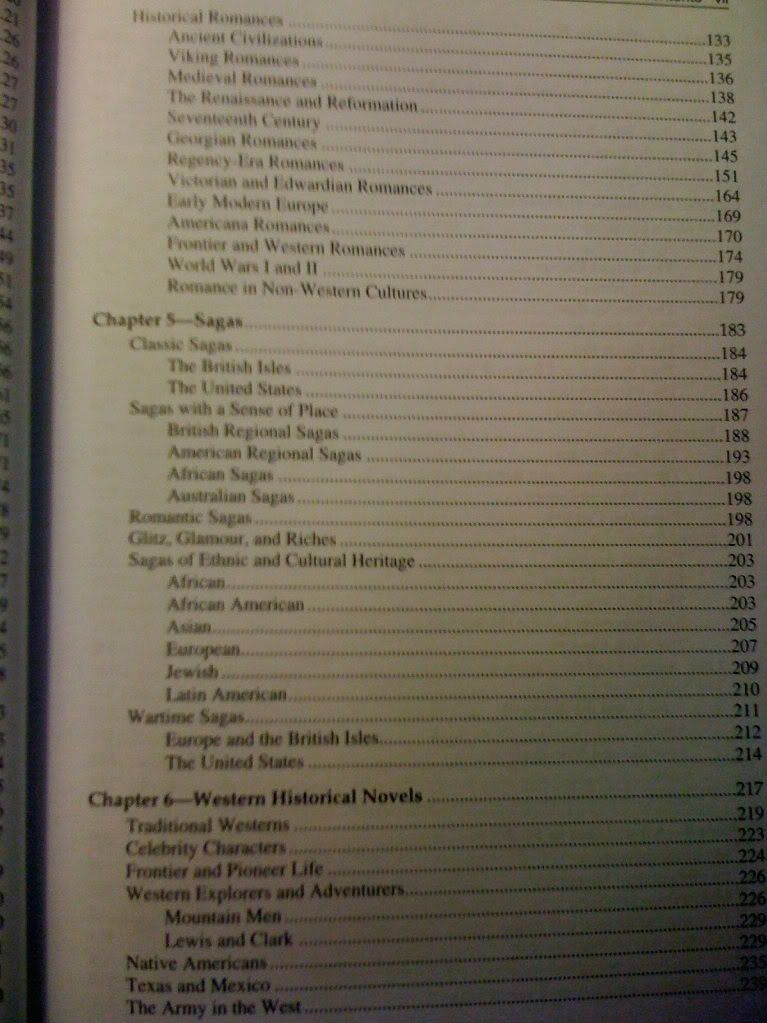
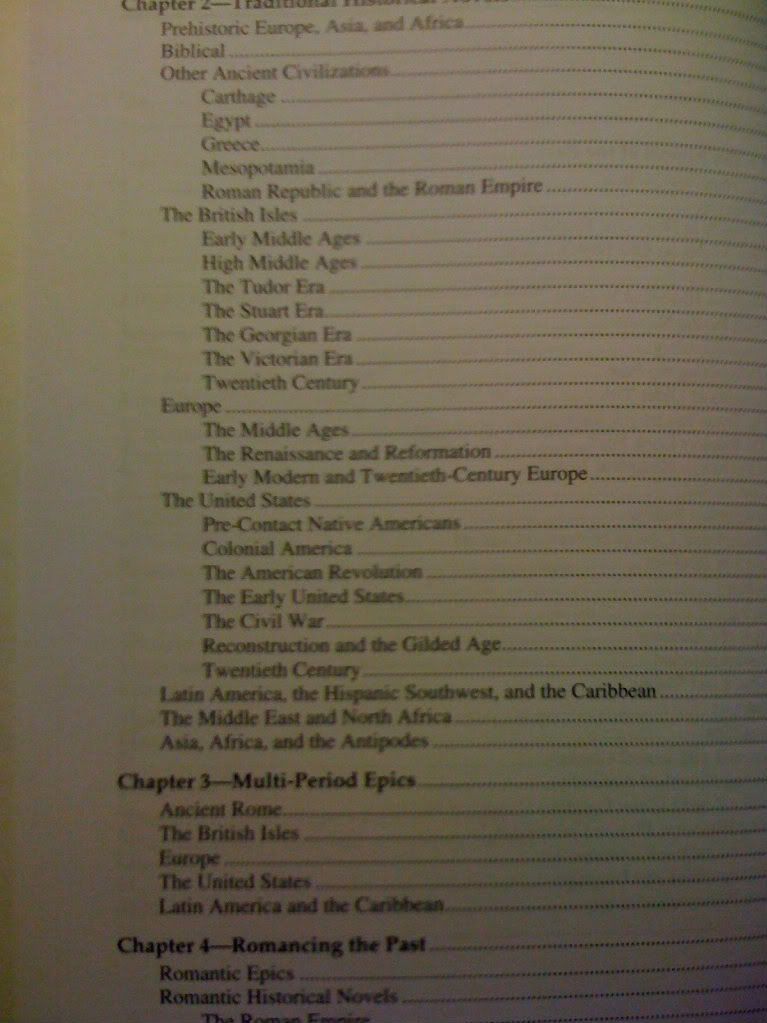 Click the pics to enlarge them.


.JPG)