Follow Us @burtonreview

Apr 27, 2011

In the Footsteps of Elizabeth I: Margaret George Does Dallas!!

Wednesday, April 27, 2011
Ok, well she DID do Dallas. I had the fabulous opportunity of meeting with Margaret George after her Arts  & Letters Live lecture that was held at the Dallas Museum in April for her Elizabeth I: A Novel tour. You can read my review of Elizabeth I here. I loved the book, and I was so thrilled that she was coming to Dallas. Margaret is very sweet in person, and her lecture spoke of her writing processes as well as her main character, Elizabeth. This couldn't come at a better time for me personally, as I feel I have now read so much on Elizabeth from non-fiction to fiction that I have a firm grasp of her character.

Yet, as Margaret suggested, there is always something intangible about Elizabeth, something vague that a reader always struggles to capture. But can a writer capture that? I believe Margaret rounded out Elizabeth's story very well for me, especially since the novel focused on the later years of her reign. Most of the reads I came across would focus on Elizabeth's lusty father and all of his wives, and if it focused on Elizabeth there were always scenes regarding Thomas Seymour or Robert Dudley. This time around, we had Dudley's step-son, the Earl of Essex as a leading character along with Lettice Knollys who is also a favorite Tudor of mine.
Margaret's lecture was titled "In the Footsteps on Queen Elizabeth I: Adventures In Research". She shared with us her experiences of becoming a writer, and her research tactics. She didn't have scholarly training as a writer, but she had great fortune to live in foreign places as a child due to father's career. Living in places like Israel, she felt very close to history as a child living next to places where historic events occurred. Her school in Jaffa, The Tabitha School, was run by strict Scottish missionaries, and was supposedly the place where St. Peter raised the little girl Tabitha who had died also known as Dorcas. She said she came from a bookish family, where her father had Ph.D. in 18th century literature and her mother taught high school English, and they all liked to read. She started writing as a hobby when she was young, from stories about horses to teenage stories as something that she did for her own pleasure. Only once she decided to write Henry VIII's story is when she became focused on her writing. Margaret wanted to introduce a young Henry to readers, when at that time there was not a lot about the young Henry as opposed to the monstrous traits that some writers focus on. Although Margaret has given us the story of Henry VIII, Mary Queen of Scots and now Elizabeth, we won't be seeing a book on Mary Tudor anytime soon from Margaret. She feels Mary's life is just so full of depressing events and it would just be sad to delve into her story.

Margaret went on to discuss her research process of reading books for research, making notations (in pencil!) in the margins, and then writing separate index cards categorized by topic. She showed us an example of an index card for her research on Elizabeth's progresses where Margaret made notes of what book referred to which progress in which year and what unique fact she learned that could be incorporated into her developing story. Elizabeth used these progresses as a bit of PR, and she liked to do them during the summer. It was very interesting to see how Margaret detailed out the pages numbers of which book to get herself organized to store facts such as how far a progress went and how long it was. Once upon a time, she used to write her huge books by hand! She also discussed the merits of first person versus third person point of views and how she used those in her books.

When Margaret is done with the actual researching of books and filling in index cards, she prefers to go to the actual places in her story. She visited the sites of Elizabeth just as she did for her previous books. At this point in the lecture, Margaret held up an Elizabeth tea cosy (audience laughed when Margaret was poking around under the tea cosy), showing how some of the royal figures in history get reduced to such a thing, but yet we still have no idea of who Elizabeth was. She really feels like the only way to get a glimpse of what's inside her character's heads is to be put in that setting of which they lived. Elizabeth left almost no private letters, and her poetry that is attributed to her cannot actually be authenticated.  We get nuances of Elizabeth through the contemporaries, but Elizabeth controlled her image as much as she could, as well as controlling what portraits were commissioned of her.

Margaret also discussed the outlook Elizabeth may have had on her beheaded mother, Anne Boleyn. She showed us a photo of the ring Elizabeth had commissioned which features both the portraits of Anne and Elizabeth. Even though she didn't attempt to rehabilitate Anne's reputation, she clearly had some bond or love of her mother simply for the fact that she wore that ring. And her father.. well, what do you do when your father beheads your mother? (More audience laughter). Elizabeth learned much from her father's reign, and she learned early on regarding the dangers of being close to the throne. Margaret shows us a portrait of Elizabeth when she was about thirteen years old, and how it was abundant with books. Did she want to portray the fact that she was a harmless bookworm, with no ambitions of the throne for herself, especially being third in line to the throne? It certainly was a clue that she was someone to not be tossed off as a silly girl. Further portraits of Elizabeth were always heavy with symbols, many dealing with purity and virginity.
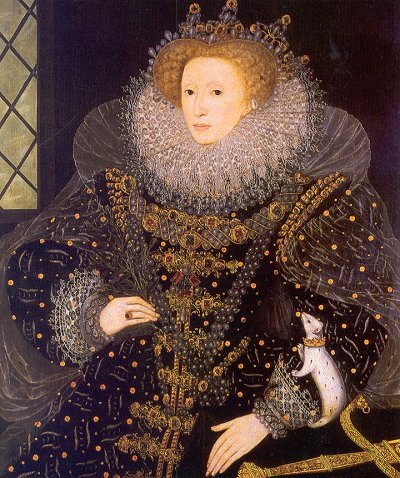
The Ermine Portrait, 1585

An intriguing fact of Elizabeth is the fact that she was the Virgin Queen. Margaret discusses how Elizabeth wouldn't marry someone among her subjects (Dudley), which leads to rivalry and maybe riots. Yet, why didn't she want to marry to merge with another foreign power? She knew that to do so, England would be put at risk after her death. She also didn't want to share her status as Queen and give off any power to a consort which would breed discontent just as Philip of Spain did when he married Elizabeth's sister, Mary I. At the time, sexual relations conferred a legal status of a relationship, thus compromising her royal sovereignty. Margaret goes further into the speculations of the marriage negotiations, and the psychological reasons behind Elizabeth's refusal to marry. As popular story goes, King Henry IV of France reportedly said that Elizabeth's maidenhead was one of the three great mysteries of his day. He did not say what the other two were!  The audience loved this little story!

Margaret talked about the major crises or her reign: Mary Queen of Scots, the Armada, and the Earl of Essex. Elizabeth was not a vicious ruler like that of her father. She didn't want to execute Mary Queen of Scots or the Earl, but only did so when she had no other choice when they threatened Elizabeth's crown. An interesting fact Margaret offered is that Essex was the last nobleman to actually challenge the crown thereafter. Elizabeth's reign did not encompass many notable positive changes or events such as the Magna Carta, yet she goes down in history as a much loved monarch.

Elizabeth loved controlling her image such as her orchestration of the famous scene of addressing her troops wearing her virginal white dress as well as a breast plate. If anyone missed the speech she wrote, Elizabeth made sure it was copied and distributed throughout the land. Margaret shows us some portraits as well as her funeral effigy. The effigy was probably made from her death mask and the closest we would come to an accurate image of her, as she was not around to make sure it make her look young and vibrant.


After discussing Elizabeth, the audience was given the opportunity to ask questions of Margaret George. She told us that she is studying Nero for her next book, as she loves larger than life characters, and it takes about five years for her books to shape out. So we'll have quite a wait, yet that gives me the chance to read the rest of Margaret George's books. I think I will start with Mary Magdalene..


Margaret George signing, & me, being ecstatic.
Of course, after the lecture, I was able to get my books signed by Margaret George! I apologize for the yucky photos, iPhones are not the best cameras.. but here I am with Margaret George! She personalized and autographed the books, and she was such a pleasure to meet. She was extremely gracious, especially by scoring me those wonderful front row seats at the Dallas Museum. I was honored to be escorted by my mum who puts up with my bookish pursuits and gets to read my books sometimes before I do! Thank you to Margaret George for giving me memories to treasure for a lifetime!
Front row reserved seats for me! Squee!!

Apr 25, 2011

22 Britannia Road by Amanda Hodgkinson, a debut novel of postwar England

Monday, April 25, 2011

22 Britannia Road by Amanda Hodgkinson
Hardcover: 336 pages
Publisher: Penguin/Viking/Pamela Dorman Books (April 28, 2011)
ISBN-13: 978-0670022632
Review copy provided by the publisher, thank you!
The Burton Review Rating: Four Stars

A tour de force that echoes modern classics like Suite Francaise and The Postmistress.


"Housekeeper or housewife?" the soldier asks Silvana as she and eight- year-old Aurek board the ship that will take them from Poland to England at the end of World War II. There her husband, Janusz, is already waiting for them at the little house at 22 Britannia Road. But the war has changed them all so utterly that they'll barely recognize one another when they are reunited. "Survivor," she answers.

Silvana and Aurek spent the war hiding in the forests of Poland. Wild, almost feral Aurek doesn't know how to tie his own shoes or sleep in a bed. Janusz is an Englishman now-determined to forget Poland, forget his own ghosts from the way, and begin a new life as a proper English family. But for Silvana, who cannot escape the painful memory of a shattering wartime act, forgetting is not a possibility.


One of the most searing debuts to come along in years, 22 Britannia Road
Light, witty, fun and entertaining this is not. Provocative, emotive and despairing it is. 22 Britannia Road follows the effects of World War II on a wife and husband who were apart for six years because of the war. Silvana and Janusz were newlyweds in Poland when Janusz goes to become a soldier, and both meet up with horrific circumstances that are beyond their control. Silvana and her son Aurek survive in the forest, making acquaintances along the way, and Janusz travels throughout Europe during the war. The novel is more character driven and not focused on the details of the war, but it was a backdrop for why these two were put in the position they were in.

Finally the two reconnect and attempt to rebuild their lives in Ipswich, England. Silvana is no longer the svelte redhead, but a gray haired mess who lived on twigs and bugs for the last six years. Their son Aurek is not quite the social butterfly. The family needs to adjust to each other, to England, and communicate through the secrets that have built walls between them. The novel's title is the address of the house that Janusz buys in England, hoping for a renewed life as an English family with English roses. They have pleasant neighbors, Janusz works hard at his job, and there should be no issues. However, there are secrets that they both keep, and the boy himself creates a lot of havoc as he doesn't fit it in at school and is not used to sharing his mother with anyone. A fantastic feature to the present story is the back and forth between time lines of the struggles during the war from each of Janusz's and Silvana's viewpoints. Sometimes this switching back and forth becomes jarring, but the author did it so well and cohesively as the underlying tone of each chapter merged with the next, it was a seamless transition.

Not just about the themes of love, friendship and loyalty, it holds the darkness of secrets and the quiet tremors of fear of one's future. The novel, along with its beautiful cover, brings about a sense of hope along with the silent plea for normalcy after such a horrific time. They all just want to be a family, but there are more than just emotional scars that hinder their progress. Laced with suspense as we watch the characters develop and self-destruct, 22 Brittania Road is a formidable page-turning debut novel that tugs at your heartstrings.

The publisher is generously offering one lucky follower their own copy of 22 Britannia Road by Amanda Hodgkinson!
To enter, leave a comment with your email address.
For extra entries, (+1) tweet this post, or (+1) facebook the link.
Open to USA, ends May 2nd. Good luck!

Apr 17, 2011

Rivals in the Tudor Court by D.L. Bogdan

Sunday, April 17, 2011

Rivals in the Tudor Court (Tudor Court 2) by D.L. Bogdan
Kensington Paperback April 26, 2011
ISBN-13: 978-0758242006
Review copy provided by the author, thank you!
The Burton Review Rating: 4 stars
The death toll in Henry VIII's England can be counted in the thousands. No one was more aware of this than Thomas Howard, third duke of Norfolk. Relying on his indomitable force of will, cleverness, and sheer good fortune, Thomas Howard manages to be one of the king's only intimates to survive an unforgettable reign of terror. This impeccably researched companion piece to "Secrets of the Tudor Court" chronicles the ambitious duke's life, loves, and remarkable capacity to endure. Before he was the king's uncle, before he was his nieces' ultimate betrayer, Thomas Howard was a hostage at the court of Henry VII while his father was imprisoned in the dreaded Tower of London. There he would marry the queen's sister, his forever princess Anne Plantagenet. While he founded a dynasty, his career as soldier and sailor brought him acclaim and the trust of the Tudors. But when unspeakable tragedy robs him of family and fortune, Thomas must begin again. Abandoning notions of love, Thomas seeks out an advantageous match with the fiery Elizabeth Stafford, daughter of the duke of Buckingham. Clever, willful, and uncompromising in principle, the young duchess falls victim to a love she cannot deny. When Thomas takes on a mistress, the vulnerable Bess Holland, Duchess Elizabeth prepares to fight for all she holds dear. Only then does she learn she faces a force darker than anything she could ever have imagined, an obsessive love that neither she nor Bess can rival.
Thomas Howard, Duke of Norfolk, was a key player both behind the scenes and not-so-behind the scenes during Henry VIII's reign. Tudor fans recognize his name as the one responsible for putting his two nieces under the King's nose, ripe for the plucking. After Henry tired of mistresses Mary Boleyn and Bessie Blount, Thomas saw that Henry had eyes for Mary Boleyn's sister, Anne. And of course the rest is history.. Anne becomes queen, fails to give Henry the male heir and is summarily executed on trumped up charges of adultery. Another niece becomes available, Kitty Howard, who moves on become another Queen Catherine to King Henry.

But who was this man, the formidable Thomas Norfolk? Behind the political movements and shrewd judgement, he is one powerful noble who managed to escape the axe, although he came close and was saved by Henry's death alone. In D.L. Bogdan's previous book, Secrets of the Tudor Court, Thomas's daughter Mary Howard was the focus of the story but the story held frightening glimpses of Thomas himself, who is better known simply as Norfolk.

Why did he seem to be so cruel to his family? He beat his wife, his children, and paid his servants to do it some more. Not a very likable creature indeed, and D.L. Bogdan take us back to Thomas's beginning as a child struggling to make up for his short stature. His desire to be the best soldier earns him recognition, and Queen Catherine of Aragon favors him as well as King Henry does. He always wants more though, and he brings his family down whomever stands in his way.

Bogdan brings us the story of Thomas as he becomes more and more powerful, while also looking at the women in his life. We are treated to a never before seen look at Thomas Howard as he is undeniably happy with his first wife Anne Plantagenet until tragedy strikes again and again. The hardened man takes another wife with Elizabeth Stafford and we hope that perhaps he can come full circle, but he becomes more and more hateful, especially as he takes on a mistress, Bess Holland. We get the point of views of Thomas, his wife Elizabeth, and his mistress Bess, as they all struggle to maintain their wicked triangle of love and hate in Thomas's cruel world. With the intermingling of their lives, Bogdan presents a page turning story of loyalty, treachery and ambition giving us the Tudor flair that fans love.

Apr 13, 2011

Finding Emilie: Guest Post by Laurel Corona

Wednesday, April 13, 2011
The following is an article written by author Laurel Corona, who has recently published her newest novel, Finding Emilie (4/12/2011), which I consumed in a weekend and loved. Emilie sounds like such a magnificent lady-- charming, scientific, exhibitionist, Voltaire's lover...


Finding Emilie, by Laurel Corona
  
Emilie du Châtelet: Physicist and Party Girl

The Marquise du Chatelet’s parlor at her husband’s ancestral home in Cirey looked in many respects like that of any other aristocrat. The banquettes were plush, the chairs ornately carved, the tea and liqueurs beautifully arrayed in Sevres porcelain cups and tinted crystal glasses, the cakes and pastries freshly baked by the servants in the basement kitchen.

Only one thing was unique: in the center of the parlor, with chairs arrayed around, was a bathtub--a bathtub with Emilie in it, happily chatting away with her guests while clothed only in a diamond necklace and a silk chemise, transparent when wet. When her water cooled, a manservant recalled in his memoir, he would bring hot water and pour it between her parted knees, which revealed, in his words, “all her nature.”

Well, why not? Emilie du Chatelet was brilliant at everything, but was best at two things: knowing what she wanted, and getting it. From the age of ten she used her prodigious mathematical intelligence to beat adults at cards at the salons, then taught herself math and science from the books she bought with her winnings. As a young wife and mother, she occasionally cross-dressed to go to scientific meetings forbidden to women. When she wanted to learn to sing, she hired one of the voice teachers at the Comedie Italienne as her private tutor, learning whole lead soprano roles by heart even if she would never sing on stage.

Vivacious, irrepressible, charming, and daring, Emilie blazed through the world of Louis XV’s France, but her corset, wig, and panniers hid the most incredible thing about her: her first-rate scientific mind. Emilie du Chatelet used her privileged life to become one of the most important women of science not just in her era but in any. The fact that she is not a household word has far more to say about others than it does about her.

Believing until her thirties that her studies were just for curiosity and that she would never amount to anything as a scientist, she spent years helping her lover, Voltaire, conduct scientific experiments and write a work on Newton which he claimed as his own work. Voltaire had no particular aptitude for such work, but he wanted a seat in the French Academy of Science as a complement to his fame as France’s preeminent man of letters. He never got close. Today, it’s commonly believed that any solid, original thinking in Voltaire’s scientific works is attributable to Emilie.

A prize offered by the Academy of Sciences for the best paper on the nature of fire caused Emilie to break away scientifically from Voltaire and submit her own paper anonymously. She did not win, but received an honorable mention and the unusual acclaim of having her paper published alongside the winner--an indication that the only reason she had not won was because the Academy was unprepared to give the prize to a woman.

She continued a dual life of courtly obligations and scientific work into her early forties, when at the unheard-of age of forty-three, she got pregnant by a dashing young soldier- poet, with whom she had a passionate affair.

Premonitions of death in childbirth caused Emilie to work at a breakneck pace on her most important work, a translation of Newton’s Principia Mathematica. But hers was no mere translation. Few could comprehend Newton’s work, so Emilie rewrote it in French that scientists could understand. She also wrote commentaries to explain and expand upon Newton’s points, and in places where Newton had not presented adequate mathematical proof, Emilie figured out what those proofs would be and supplied the equations. Her translation of Newton’s Principia is still, 250 years later, the standard one used in France.

Unfortunately, Emilie’s premonitions turned out to be true. After an uneventful labor and delivery, she died six days after the birth of a daughter, Stanislas-Adelaide, probably of an embolism.

My novel is about finding Emilie on many levels. First, I “found” her and wanted to tell her story. But the book is less about her than her daughter. Effectively orphaned, Lili (as the girl is known) grows up, at least in my imagination, as unusual and independent of mind as the scandalous woman who bore her. Reaching her teens, Lili’s world closes around her as an impending loveless marriage threatens to take away her independence of spirit and dreams for her future. Believing that learning about her mother may point the way for her own life, she sets out to find Emilie for herself. Last, readers will find Emilie through the real-life scenes that appear between the chapters.


Welcome to 2011, Madame la Marquise! A more appreciative world awaits.
 
~~
Thanks to Laurel Corona for providing her with this piece! Her books can be found at online retailers at the following links:
Amazon
Barnes and Noble
Book Depository
Borders

The Burton Review posted a review of Finding Emilie here, and the author's previous release Penelope's Daughter here. Visit more articles by Laurel Corona here and here.

Apr 11, 2011

Finding Emilie by Laurel Corona

Monday, April 11, 2011


Paperback, Simon & Schuster, April 12, 2011
Review copy provided by the publisher, thank you!
The Burton Book Review Rating: 5 stars
Woman is born free, and everywhere she is in corsets. . . .


Lili du Chatelet yearns to know more about her mother, the brilliant French mathematician Emilie. But the shrouded details of Emilie's unconventional life—and her sudden death—are elusive. Caught between the confines of a convent upbringing and the intrigues of the Versailles court, Lili blossoms under the care of a Parisian salonniere as she absorbs the excitement of the Enlightenment, even as the scandalous shadow of her mother's past haunts her and puts her on her own path of self-discovery.

Laurel Corona's breathtaking new novel, set on the eve of the French Revolution, vividly illuminates the tensions of the times, and the dangerous dance between the need to conform and the desire to chart one's own destiny and journey of the heart.
Finding Emilie is about a young lady, Lili, looking to replace the void that was created within her as her mother, Emilie, passes away soon after Lili's birth and her father wants nothing to do with her. It starts off with a group of letters which sets the scene for how Lili came to be and for a bit of characterization of the supporting figures that are in her life.


Lili grows up with Delphine and is treated as part of the family under Madame de Bercy's roof, and where she is allowed to cultivate the spirit and inquisitive nature that she inherited from her scientific mother. The setting is the Enlightenment age of France, even though Voltaire's wild views were ridiculed by the French government. Lili and Delphine prosper under Delphine's mother's watchful but tolerant care, and eventually the two realize they must part and make good marriages. What comes next is the proverbial race to the finish line, hoping against hope the two girls will be able to make marriages that are both advantageous and amenable at the same time.

Much like the stories that I grew up with, there is a lot of wishful thinking and fairy-tale whimsies so typical in young girls, but I loved the way it was told. I was totally immersed in the character of Lili, even though it was told in third person I felt very close to her throughout Lili's story of self-discovery. Even though there were a lot of scientific references as Lili explored flowers under microscopes and thought about philosophies, I was not put off with the amount of it. I must have felt I was close to discovering the meaning of the universe right along with Lili.

A strong feature of the novel were the very characters, from the boys to the men and the servants in the many grand houses that were frequented. There were balls and the queen, and Voltaire, too. I loved feeling like I was whisked away to another time, as author Laurel Corona captured the essence of her characters with exquisite detail, making me feel like I had lost a friend when I concluded the novel. I was not disillusioned at all with the fact that the novel focused more on the character of Lili rather than solely on the historical details of the pre-revolutionary France, as I did not pick up the book with any expectations of the latter. By doing so, I was taken by surprise with how Laurel Corona's writing immediately drew me into her reimagined world of the daughter of Emilie du Châtelet and the story of her coming of age. Finding Emilie goes easily on my favorites of 2011 list.

Apr 8, 2011

Wickham's Diary by Amanda Grange

Friday, April 08, 2011
Wickham's Diary by Amanda Grange
Paperback: 208 pages
Publisher: Sourcebooks Landmark (April 1, 2011)
ISBN-13: 978-1402251863
Review copy provided by the publisher, thank you!
The Burton Review Rating: 4 stars
This prequel to Pride and Prejudice begins with George Wickham at age 12, handsome and charming but also acutely aware that his friend, Fitzwilliam Darcy, is rich, whilst he is poor. His mother encourages him to exercise his charm on the young Georgiana Darcy and Anne de Bourgh in the hopes of establishing a stable of wealthy social connections.


 At university, Darcy and Wickham grow apart. Wickham is always drinking and wenching, whilst Darcy, who apparently has everything, is looking for something he cannot find. Wickham runs through the money Darcy gives him and then takes up with the scandalous Belle, a woman after Wickham's own greedy, black heart.
Wickham's Diary is a quick little foray into Austen's famous Pride and Prejudice characters and is worth each little page it is printed on. It can be seen as a sort of prequel to P&P from wicked Wickham's point of view as he grows more and more jealous of the brooding Darcy. Everything Wickham has he owes to the elder Mr Darcy's generosity, yet George Wickham had known from the start that he must marry an heiress in order to sustain his lifestyle. Not a very likable character is he, but a fun read nonetheless as I really enjoyed the inside look at George as he schemes for his fortune.

The best part of the story was learning the background of George's parents, and I loved the character of his mother. Our favorite Darcy himself is not a big feature, as this novella is written diary style through Wickham and speaks of how annoyed Wickham is with Darcy. Georgiana is indeed a more featured character as George sets his sights on her, and I really wish the ending hadn't ended the way it had because it felt like there was a lot more to occur at that particular moment. There was no real sense of closure, but perhaps the author was leaving that up to Austen's Pride and Prejudice itself. Also, one must take into account this is a novella, and was seemingly meant as a explanatory precursor to the wild antics of George Wickham in Pride and Prejudice. I enjoyed it very much, and would have loved to have read it as an in depth novel. Grange's writing is perfect for evoking Austenesque tones and I look forward to perusing her backlist such as Mr. Darcy's Diary: A Novel, Captain Wentworth's Diary and Colonel Brandon's Diary.

Apr 5, 2011

It's April 5, Everyone!! Updates and housekeeping (ugh!)

Tuesday, April 05, 2011
What a great day it is today!! April 5 is my son's 4th birthday!! Happy Birthday to my little Oliver.. he was much wished for and I couldn't have asked for a little boy more perfect than my little guy. Oliver's big sister is pretty special too, and we are going to Chuck E Cheese.. the mother of all Kids Fun places, as it is always picked by the kiddos for their birthday celebrations. Since my stepdaughter is almost 17, I feel like I've been going to Chuck E Cheese's for quite a few years. Now I feel old.


Another fabulous reason for April 5 being a great day is that two of the favorite books that I've read this year are being released!!


TO BE QUEEN by Christy English... And you can enter right here to win your own copy of this great story of Eleanor of Aquitaine. Two lucky winners, plus it's an international giveaway! I highly recommend this title, and you can see my review by clicking here!

Elizabeth I: A Novel by Margaret George (click for review).. another huge chunky book but I loved every page of it! This is a fabulous book and I am looking forward to reading her backlist after this reading experience. And I get to meet the author tomorrow night at the Arts and Letters Live Lecture at the Dallas Museum!!

If you are in the Dallas area, you won't want to miss this chance to learn about Margaret's research on one of our favorite historical figures. Rest assured, I will be posting all about my experience, I am so excited to meet her!!

And as a side note, some not-so-nice person decided to open apparently a fake wordpress blog called The Burton Review, using my old domain which I lost several months ago due to Google technical errors. It has been a nightmare, and I almost wanted to give up the blog altogether I have been so frustrated with these domain issues.

So now when I am googled as The Burton Review, that fake site comes up. GRRR!! In an effort to not have another fake site pop up, I have again purchased another domain, http://www.burtonbookreview.com/ but the blogspot domain will auto-direct you to the current site, thankfully. When you have time, update your bookmarks and links to http://www.burtonbookreview.com/ and I would really appreciate it so very much. The more times Burton Book Review gets googled and clicked hopefully it will knock out the old domain off its pedestal as top of the list. Which I loved being top of the list back when it was mine! Again, another GRRR.

If you are a new linker, and would like an  updated button, please use the button below. I have made it a little smaller than the previous button, so if it is on your sidebar this one may fit better anyway. Let this be a warning to others.. purchase the variants of your "trade name" if possible as far as .net and .org etc because this has been a headache.

And on yet another frustrating note, for those who subscribe to this feed via Google Friend Connect, I have no idea why but the feed may not be updating in Google Reader. If you can, I would appreciate it if you signed up to receive my posts via email instead of relying on the google reader, which hasn't updated in a month for me, but it did for one of my followers (confused!). On the top left hand corner of my sidebar, you can sign up to receive the emailed updates. I have a sneaky suspicion that my traffic has dwindled because of the stupid google reader not updating.

If you do use Google Reader, you need to hit the link under the Email Subscribe, and subscribe in a reader..
Subscribe to The Burton Review and once your are there click ADD SUBSCRIPTION.
That should update your feed to your google reader since I just set that one up. Definitely the most sure-fire way to receive my posts would be the Email Direct feature, but it couldn't hurt to try both. Annoyance, right? Why does Google make everything so difficult?!

In case blogspot users weren't aware (I wasn't till today).. there is a spot on the Settings for Email & Mobile. Once you find that page from your dashboard, you can select the option to convert your pages to Mobile-friendly on mobile devices. This is a feature that I think everyone should use.. especially those blogs like mine that are heavy on the graphics, and it makes the mobile surfer much happier to be able to see your actual content much better. There are some bloggers who don't realize that their text doesn't show up on mobile devices because your backgrounds don't show up. For one particular blog I attempted to visit on the mobile phone there is a white background and white text... makes it kind of difficult to read it.

The NEW button!
HAVE I LOST YOU YET?! HANG ON!! Onwards to happier things...I wanted to direct you to a new spot on HF Connection which features a guest post from book/author publicist Diane Saarinen whom many of my fellow book bloggers may have worked with before. Diane would love to see some of your thoughts on the topic of Pitching Book Bloggers. She mentioned one of my pet peeves how authors out of the blue tell me when they want me to run a review, even though they have never read my review policy. They don't seem to realize that we book bloggers take time out of her personal lives to offer our book reviews, and many of us work full time and have families to take care of first. Before I go crazy venting here..hop on over to Historical Fiction Connection and join in on the discussion. You also have the opportunity to purchase her newest ebook on Pitching Book Bloggers, and if you are a book blogger you can get it free.

Happy April 5th everyone, Happy Birthday to my crazy Oliver, and Happy Release Day to Christy English and Margaret George!!

Apr 1, 2011

To Be Queen by Christy English

Friday, April 01, 2011

To Be Queen by Christy English
Paperback, 400 pages
April 5th 2011; NAL Trade
ISBN13 978-045123230
Review Copy provided by the author, thank you!
The Burton Review Rating: 4.5 stars

Christy English's second novel brings us her favorite protagonist of Eleanor of Aquitaine. English's previous work of last year, The Queen's Pawn, focused on the relationship between Eleanor and her ward, Alais, who was purpoted to be a mistress of Eleanor's second husband. For this novel, the author steps even further back in time to bring us a prequel to the tumultuous marriage of Eleanor and Henry and brings us the early years of Eleanor as she sows the seeds of ultimate strength and power as only she could.

Eleanor was a woman brought up to believe in herself and Aquitaine as her legacy, above all things. As she recognizes that her dream of becoming a Queen of France was not as fruitful as she would have imagined, she begins to realize that being Queen alongside the pious King Louis was only holding her back. We are always hurried through this marriage to France with our previous Eleanor reads, but now the author takes the time to reimagine this time of Eleanor's life and attempts to prove just how worthy of a woman Eleanor truly was.

Louis wasn't that man to make Eleanor be all that she knew she could be.. and the vassals and priests of Louis' court weren't about to make her feel welcome. Eleanor is unfulfilled in many ways, and the lack of a son and heir for France finally gives Eleanor a way out of the marriage. As that is the simply put timeline of Eleanor's marriage to Louis, the author weaves for us an incredible journey of passion, power, manipulation, lust and greed into a compelling story of Eleanor of Aquitaine. Before the infamous devil's brood, before Henry II locked the scheming Eleanor away, the author gives us the glimpse into the woman that always knew she was destined for the greatest things.

The author's prose drew me in in the beginning, and I was very impressed with how the story had moved along with its atmospheric tones. Towards the end, though, I admit to being tired of the romps in the gardens of Persian roses.. the author takes several liberties with the fiction part but you need to take it as a whole package and simply embrace it. Although the first half seemed stronger than the last, I still enjoyed the entire book immensely and can appreciate the strength and will power of Eleanor that Christy English successfully portrays through To Be Queen. I can also appreciate the rare look at the early life of Eleanor, which is often rushed through. Eleanor's sister Petra is featured somewhat, as well as Louis VII in all his pious inadequacies, but we also have Amaria who is seemingly the most loyal servant and helpful person to Eleanor throughout. The court of love that Eleanor is famous for is also a theme in this story which helps flesh out the character of Eleanor as she strives to maintain her sense of loyalty to her family name and her homeland. Of all the amazing things that Eleanor has done in her life, the fact that she was a queen twice is pretty significant, as well as the fact that barons of Aquitaine swore allegiance to her as a young woman. That Eleanor of Aquitaine is a legend in her own right is a wonderful excuse for women to feel more empowered after reading of all that she accomplished and endured.

If you are looking to either aquaint yourself with Eleanor or if you consider yourself well-versed on her life, I would recommend Christy English's passionate novel on Eleanor which offers a look into the beginnings of the Queen like no other novel before her. You can start with both of English's novels on Eleanor, and I then suggest you move on Sharon Kay Penman and read the trilogy that begins with When Christ and His Saints Slept which will bring you deeper into the history of England following the steps that start with the usurper King Stephen and end many years later with Eleanor's youngest son King John (of Elizabeth Chadwick fame).

Mar 29, 2011

Elizabeth I: A Novel by Margaret George

Tuesday, March 29, 2011

Elizabeth I: A Novel by Margaret George
Hardcover: 688 pages
Publisher: Viking Adult (April 5, 2011)
ISBN-13: 978-0670022533
Review copy provided by the publisher, with many thanks!!
The Burton Review Rating: five big stars


Margaret George is one of those iconic historical fiction authors that even if you have not read her books, you have heard of her. I have been collecting her books but have not been able to read them as they look so daunting in size. This year, fans are treated to another tome by Margaret George as she brings us a novel on Elizabeth I. This is not your ordinary Elizabeth I novel for two reasons: 1. It is written by Margaret George. 2. It begins in 1588, when Elizabeth is fifty-five and about to face the Spanish Armada.

I was ecstatic when I realized this was not another rehash of Elizabeth's life from Thomas Seymour's pats on her butt to her struggles during her sister's Mary's reign, though it does cover the rise and fall of the Earl of Essex in detail. I was then overly ecstatic when I realized that this novel also features Lettice Knollys, whom Elizabeth liked to call the she-wolf. My Enemy The Queen by Victoria Holt was one of my favorite Tudor reads and I loved Lettice as she tried to out-maneuver Elizabeth every chance she got. The rivalry was heightened when Lettice married Elizabeth's favorite, Robert Dudley the Earl of Leicester.

Elizabeth I: A Novel read very much like the Dickens' favorite A Christmas Carol. We see through the aged Elizabeth's eyes the ghosts of the past from her parents to her favorites who flit in and out of her consciousness; the present with the younger courtiers who no longer have anything of value to Elizabeth except their looks; the future of England because of course this Virgin Queen left no heir for England. The decisions of the past and the present and how they affect the future of England are also an underlying theme for Elizabeth as she struggles to maintain her hold on the country that she married for richer or for poorer. The Spanish Armada was always a threat, and even though she was able to defeat it in 1589, by the time Spain had rebuilt its forces to strike again, Elizabeth's most trusted advisors and the strongest fighters and nobles had withered away.

Elizabeth hated most of all Lettice Knollys, who had secretly married Elizabeth's perhaps one true love Robert Dudley. Lettice was like Elizabeth in many ways as far as stubbornness and force of will, but promiscuous Lettice lacked the self-control of the Virgin Queen. Lettice was also the mother of Elizabeth's next favorite after Robert Dudley, the Earl of Essex Robert Devereux. In and out of this story of Elizabeth we are treated to chapters devoted to Lettice, as she struggles in vain to regain all that she has lost since Robert Dudley's death. Her one shining hope remains with her son the Earl of Essex, as he hopes for favors from Elizabeth I to help sustain his family. Robert Devereux is headstrong and unruly, and both Lettice and Elizabeth had difficulty with restraining Robert's self-destruction, and this spiral of love and hate between the Queen and Essex became interwoven into the novel as a major theme.

There were many names and titles, and a few Roberts as Robert Cecil is also featured here. There were even surprising occurrences behind closed doors, including the famous Will Shakespeare. The cousins descended from the Boleyn family are a strong part as the old loyal favorites of Elizabeth who always stayed loyal. And yet there were always some who were tired of Elizabeth's Protestant ways as more religious strife occurred with both Catholics and Puritans. The crisis in Ireland and the years of crop failure are another focus as Elizabethans struggled to maintain the Golden Age. The wax and wane of Elizabeth's reign is well known to Tudor fans, but I have not read any novels that actually spotlight their entire work on the wane of Elizabeth's life such as Margaret George's does here. Names of courtiers are weaved in and out of the story like our own old friends, so that those readers familiar with the Tudor era will feel right at home without getting another monologue of the backstory of each person. It is only for that reason that newbies to the Elizabethan era may find themselves lost in the vague comings and goings of the important people of Elizabeth's time, but as a lover of Tudor fiction I appreciated it as the minute details are lightly touched upon as a refresher.

The first person point of view of Elizabeth (and intermittently Lettice) seemed spot on.. the face on the outside to her subjects being different than the thoughts swirling in her head; slightly sarcastic and witty in her aging years even though she seemed a bit shocked that she was as old as she was. The magnificence of this tome is the way that George encompasses the era, without leaving out the other minor and major players of the court. This novel is by far the most human look at Elizabeth that I've ever read as the author brings Elizabeth to grips with her legacy that includes her executed mother and her tyrant father. I especially loved the secret garden scene at Hever Castle.

 This is a very detailed book and even though it is fiction I felt like I was being educated during the read. I loved this look at the last decade of Elizabeth's reign, and admired the amount of facts and the imagery that were blended throughout the story. This is the epitome of a well-researched book, and since it was enjoyed on so many levels it would be remiss if you did not include this latest Elizabeth I novel on your Tudor bookshelf. Elizabeth I: A Novel is an absolute must read for Elizabeth I fans, as this novel is a fitting tribute to the woman and Virgin Queen that seemed to outwit many of her enemies and always made sure she was above reproach. This one is certainly going on my Favorites of 2011 post.

Other pieces that I recommend that deal with the fall of Essex and his relationship with Elizabeth are Elizabeth & Essex: A Tragic History by Lytton Strachey and  The Private Lives of Elizabeth and Essex, a 1939 movie featuring Bette Davis. Also, I have yet to read The Walsingham Woman, by Jan Westcott, about Frances Walsingham married to Phillip Sidney first then the Earl of Essex. Frances is mentioned a lot in George's novel which is why I include Westcott's here. And as mentioned before, there is Victoria Holt's My Enemy the Queen which I loved. 

I was also beyond excited to be able to see Margaret George speak for the Arts & Letters Lectures held at the Dallas Museum as part of her book tour for Elizabeth I. Yoy can visit this link to see if she will be coming to a town near you!

Read all about my fabulous experience of meeting Margaret George in Dallas here.

Mar 21, 2011

Q&A with Geraldine Brooks, author of CALEB’S CROSSING

Monday, March 21, 2011
Q&A with Geraldine Brooks, author of CALEB’S CROSSING

The publisher has provided permission to The Burton Review to post the following interview with author Geraldine Brooks. Geraldine is the author of several prize winning novels, such as March, and Year of Wonders: A Novel of the Plague.


A richly imagined new novel from the author of the New York Times bestseller, People of the Book.


Once again, Geraldine Brooks takes a remarkable shard of history and brings it to vivid life. In 1665, a young man from Martha's Vineyard became the first Native American to graduate from Harvard College. Upon this slender factual scaffold, Brooks has created a luminous tale of love and faith, magic and adventure.

The narrator of Caleb's Crossing is Bethia Mayfield, growing up in the tiny settlement of Great Harbor amid a small band of pioneers and Puritans. Restless and curious, she yearns after an education that is closed to her by her sex. As often as she can, she slips away to explore the island's glistening beaches and observe its native Wampanoag inhabitants. At twelve, she encounters Caleb, the young son of a chieftain, and the two forge a tentative secret friendship that draws each into the alien world of the other. Bethia's minister father tries to convert the Wampanoag, awakening the wrath of the tribe's shaman, against whose magic he must test his own beliefs. One of his projects becomes the education of Caleb, and a year later, Caleb is in Cambridge, studying Latin and Greek among the colonial elite. There, Bethia finds herself reluctantly indentured as a housekeeper and can closely observe Caleb's crossing of cultures.

Like Brooks's beloved narrator Anna in Year of Wonders, Bethia proves an emotionally irresistible guide to the wilds of Martha's Vineyard and the intimate spaces of the human heart. Evocative and utterly absorbing, Caleb's Crossing further establishes Brooks's place as one of our most acclaimed novelists. 

Caleb Cheeshahteamauk is an extraordinary figure in Native American history. How did you first discover him? What was involved in learning more about his life?

The Wampanoag Tribe of Gay Head/Aquinnah are proud custodians of their history, and it was in materials prepared by the Tribe that I first learned of its illustrious young scholar. To find out more about him I talked with tribal members, read translations of early documents in the Wopanaak language, then delved into the archives of Harvard and the Massachusetts Bay Colony, especially the correspondence between colonial leaders and benefactors in England who donated substantial funds for the education and conversion to Christianity of Indians in the 17th century. There are also writings by members of the Mayhew family, who were prominent missionaries and magistrates on the island, and John Cotton, Jr., who came here as a missionary and kept a detailed journal.

  
There is little documentation on Caleb's actual life. What parts of his life did you imagine? Do you feel you know him better after writing this book, or is he still a mystery?

The facts about Caleb are sadly scant. We know he was the son of a minor sachem from the part of the Vineyard now known as West Chop, and that he left the island to attend prep school, successfully completed the rigorous course of study at Harvard and was living with Thomas Danforth, a noted jurist and colonial leader, when disease claimed his life. Everything else about him in my novel is imagined. The real young man—what he thought and felt—remains an enigma.

Bethia Mayfield is truly a woman ahead of her time. If she were alive today, what would she be doing? What would her life be like with no restrictions?

There were more than a few 17th century women like Bethia, who thirsted for education and for a voice in a society that demanded their silence. You can find some of them being dragged to the meeting house to confess their "sins" or defending their unconventional views in court. If Bethia was alive today she would probably be president of Harvard or Brown, Princeton or UPenn.

 The novel is told through Bethia's point of view. What is the advantage to telling this story through her eyes? How would the book be different if Caleb were the narrator? 
I wanted the novel to be about crossings between cultures. So as Caleb is drawn into the English world, I wanted to create an English character who would be equally drawn to and compelled by his world. I prefer to write with a female narrator when I can, and I wanted to explore issues of marginalization in gender as well as race.

Much of the book is set on Martha's Vineyard, which is also your home. Did you already know about the island's early history, or did you do additional research?

 I was always intrigued by what brought English settlers to the island so early in the colonial period...they settled here in the 1640s. Living on an island is inconvenient enough even today; what prompted the Mayhews and their followers to put seven miles of treacherous ocean currents between them and the other English—to choose to live in a tiny settlement surrounded by some three thousand Wampanoags? The answer was unexpected and led me into a deeper exploration of island history

You bring Harvard College to life in vivid, often unpleasant detail. What surprised you most about this prestigious university's beginnings?
For one thing, I hadn't been aware Harvard was founded so early. The English had barely landed before they started building a college. And the Indian College—a substantial building—went up not long after, signifying an attitude of mind that alas did not prevail for very long. It was fun to learn how very different early Harvard was from the well endowed institution of today. Life was hand to mouth, all conversation was in Latin, the boys (only boys) were often quite young when they matriculated. But the course of study was surprisingly broad and rigorous—a true exploration of liberal arts, languages, and literature that went far beyond my stereotype of what Puritans might have considered fit subjects for scholarship.

 As with your previous books, you've managed to capture the voice of the period. You get the idiom, dialect, and cadence of the language of the day on paper. How did you do your research?
I find the best way to get a feel for language and period is to read first person accounts—journals, letters, court transcripts. Eventually you start to hear voices in your head: patterns of speech, a different manner of thinking. My son once said, Mom talks to ghosts. And in a way I do.

 May 2011, Tiffany Smalley will follow in Caleb's footsteps and become only the second Vineyard Wampanoag to graduate from Harvard. Do you know if this will be celebrated?
In May Tiffany Smalley will become the first Vineyard Wampanoag since Caleb to receive an undergrad degree from Harvard College. (Others have received advanced degrees from the university's Kennedy school etc.) I'm not sure what Harvard has decided to do at this year's commencement, but I am hoping they will use the occasion to honor Caleb's fellow Wampanoag classmate, Joel Iacoomis, who completed the work for his degree but was murdered before he could attended the 1665 commencement ceremony.

Stay tuned to The Burton Review for the book review of Caleb's Crossing!!


Mar 16, 2011

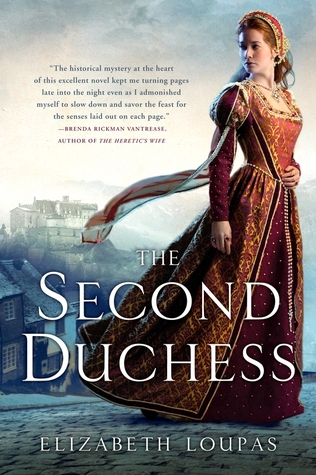
The Second Duchess by Elizabeth Loupas

Wednesday, March 16, 2011
The Second Duchess by Elizabeth Loupas
Paperback: 400 pages
Publisher: NAL Trade (March 1, 2011)
ISBN-13: 978-0451232151
Review copy provided by the publisher, thank you!
The Burton Review Rating: 4 stars

In a city-state known for magnificence, where love affairs and conspiracies play out amidst brilliant painters, poets and musicians, the powerful and ambitious Alfonso d'Este, duke of Ferrara, takes a new bride. Half of Europe is certain he murdered his first wife, Lucrezia, the luminous child of the Medici. But no one dares accuse him, and no one has proof-least of all his second duchess, the far less beautiful but delightfully clever Barbara of Austria.

 At first determined to ignore the rumors about her new husband, Barbara embraces the pleasures of the Ferrarese court. Yet wherever she turns she hears whispers of the first duchess's wayward life and mysterious death. Barbara asks questions-a dangerous mistake for a duchess of Ferrara. Suddenly, to save her own life, Barbara has no choice but to risk the duke's terrifying displeasure and discover the truth of Lucrezia's death-or she will share her fate.

The young Lucrezia de Medici was the first duchess to the powerful Alfonso d'Este, a Duke of Ferrara with eyes for greatness. Lucrezia was found dead in a monastery and Alfonso required a second wife. Enter Barbara, Archduchess of Austria, and they were married in 1565. Elizabeth Loupa's suspenseful novel of The Second Duchess is a thrill of a ride as Barbara tries to unravel all the mysteries of her predecessor's past. She arrives at her new court full of hope for a successful marriage and a bright future, but the demons of the past must be silenced in the only way Barbara knows how.. which is to discover the nasty truths.

Alfonso is a man to be feared. His grandmother was Lucrezia Borgia, and just that name of Borgia summons thoughts of poisons and murder. It is quite possible Alfonso murdered the first duchess.. and Barbara finds out first hand how cruel he can be. Barbara has few friends at the court of Ferrara, and those are the ones that she brought with her from Austria. Barbara is fearful but resolute.. she must find out what happened to Lucrezia de Medici so that she can silence the whispers that are told behind her back. She is in danger herself as she gets closer to the truth, and just when I think that's it.. I've got it figured out!! Another proverbial bomb drops and off we go with another mystery...it was one twist after another leading this reader in and out of the story with perfect precision of suspense and ghostly apparitions. I can't go further into the story without spoiling the plot, but there are wonderful things like devious nuns, knife-wielding husbands and forbidden books! The entire focus of the novel is the suspense, so that pure historical fiction lovers who do not enjoy mysteries as much may not like this novel as much as I did. There were the mysteries behind each of the characters as we didn't know who was part of what conspiracy, but there was also the facet of the relationship between Barbara and her new husband Alfonso. I love the added layers of mystery to historical characters, so this book was a quick light read for me that was very hard to put down.

Using Robert Browning's 1842 poem "My Last Duchess" as inspiration, debut novelist Elizabeth Loupas surprises us as she masterfully reimagines the arrival of the second duchess and successfully blends historical fiction with suspense that I think fans of the two genres would love this bit of court intrigue.

Mar 13, 2011

Historical Movies featuring Plantagenets and Tudors, Oh my!

Sunday, March 13, 2011
Praise the Lord for Netflix. There are days when I just don't feel like opening a book. Let's watch some good old historic movie to ease me into my dreams.. such as The Lion In Winter or Wallis & Edward.

Movies that I have never been able to watch before are now delivered to my mailbox courtesy of my very tolerant husband's Netflix account.

I wanted to share some of the winners (& losers) that I've come across these past weeks. If you don't have a Netflix account, let me tell you that I am impressed with the quick turn around of the DVD's incoming and outgoing. There is an option to view them instantly on your computer or iPhone, or you can go the DVD route, which is what I prefer.

My favorites that I've watched so far are The Lion In Winter and The Private Lives of Elizabeth and Essex: each old classic movies that I am sad I've waited this long to see.
 
Hepburn as Eleanor of Aquitaine with her son Richard (Anthony Hopkins!)
Even though The Lion In Winter is another movie that is historically inaccurate, I loved the way Henry II & Eleanor of Aquitaine bantered back and forth. Katharine Hepburn and Peter O'Toole were perfect frenemies together, and debuts by Anthony Hopkins and Timothy Dalton were superb as well. (Hopkins looked like he could squish Dalton with his thumb!)


(Email subscribers need to click through for this fabulous video).


Even though the movie spans a simple (fictitious) Christmas season, the references within the dialogue to all of the major events (fights, betrayals etc) in their lives were a treat for this Eleanor fan. The quips coming out of Hepburn's mouth as Eleanor were fast, furious and hilarious! Alys (the same Alais from The Queen's Pawn by Christy English) was also very well portrayed by Jane Merrow, and she was a vixen you would love to hate. I could go on and on about the rest of the cast, and the sinister plot line to kill one's sons and fathers.. but you'll just have to watch it yourself!


Bette Davis as Elizabeth in The Private Lives of Elizabeth and Essex (1939) was very well done and so far the most passionate Elizabeth I portrayal I've seen, even though Helen Mirren and Cate Blanchette are well known for their more recent roles. The romance lovey-dove must-have-you-desperation theme was incredibly overplayed but Bette Davis and Errol Flynn were indeed glorious in their roles. There is a fantastic mirror smashing scene that stands out in my mind.

The Madness of King George (1994) was pretty sad for its subject matter as it seems King George's son was just waiting for his old dad to kick the bucket, and although the acting seemed well enough there wasn't a fabulous impression made on me after it was over. Definitely an interesting portrayal by Helen Mirren as  Queen Charlotte. Of course this time period is much later on after the Tudor era and I still prefer earlier history thus far.

 Lady Jane (1986, Carey Elwes, Helena Bonham Carter) was beautifully done although completely inaccurate, pretending there was a real romance between the two forced into marriage. This will probably be the favorite role that I have seen Helena Bonham Carter in. Patrick Stewart as Henry Grey Duke of Suffolk was a bit much for my senses, but his wife Frances Brandon was quite a witch! I have always had trouble picturing King Edward VI as a king.. but the portrayal here was perfect for easing the ambiguity in my mind.

Richard III (1995) was horrific and I could not finish it. I had hoped for so much more. The Shakespearean dialogue talking to the camera thing was just completely annoying, and, yes, I even took Shakespeare in college as I had enjoyed him so much when a student. To top it off, this Richard III film was set in 1930's. Ick.

Wallis & Edward (2005) was impressive and intrigued me about that time in England's monarchy, where a king chose his lover over the throne. Joely Richardson as Wallis Simpson was fantastic, and I noticed the splendid scenery in this one, perhaps it was just my love for all things vintage.

A Man for All Seasons (1966) was another great classic movie, and perfect for Thomas More fans, as it was focused on his plight rather than Henry VIII. And an ideal role for Paul Scofield as he was a magnificent Thomas More. It was a pity that the movie only focused on Thomas's disagreement over 'the great matter' with Henry VIII, as he was much more of a scholar than to be reduced to that one event. I also felt Robert Shaw was a remarkable Henry VIII and I would have loved to see more of him.

Some of the movies I have seen before the Netflix proved its worth are Anne of A Thousand Days and Mary Queen of Scots which my father had bought for me in a DVD set. Both are wonderful movies that I am glad to have in my collection. I have also seen Duchess, though Knightly irritates me for some unknown reason, so it hasn't really made an impression on me either way yet. The story was a new one for me and I probably didn't understand much of it.. something of a triangle thing. I have seen Elizabeth I and The Golden Age flicks along with The Queen with Helen Mirren but still prefer Bette Davis's portrayal. Of course I have seen 2008's The Other Boleyn Girl and after I got over that horrific rape scene it was a decent movie although we can all talk circles around it regarding inaccuracies etc. I didn't really like Scarlett Johansson in that one though. I still have to watch the 2003 version.

So far it seems the old adage oldie but goodie holds true! What British-themed historical movies have you seen that you would recommend to me? I still have some more to go on the Netflix account but I think I've seen the ones that I really wanted to thus far. What's next scattered around the 65+ queue on my Netflix are The Libertine (long wait, sigh), Young Victoria, and Elizabeth and Mrs. Brown. I also went ahead and put the BBC series of Robin Hood on there which I have only heard fantastic things about. Perhaps I can get the husband interested in that one.

Mar 7, 2011

The Queen's Rival by Diane Haeger

Monday, March 07, 2011

The Queen's Rival by Diane Haeger
New American Library, March 1, 2011
Review copy provided by the publisher, thank you!
The Burton Review Rating: 4 stars


As the beautiful daughter of courtiers, Elizabeth "Bessie" Blount is overjoyed when she secures a position as maid of honor to Katherine of Aragon. But when she captures the attention of the king himself, there are whispers that the queen ought to be worried for her throne.
When Bess gives birth to a healthy son the whispers become a roar. But soon the infamous Boleyn girls come to court and Henry's love for her begins to fade. Now, Bess must turn to her trusted friend, the illegitimate son of Cardinal Wolsey, to help her move beyond life as the queen's rival.

Finally a novel on Bessie Blount! Her name has followed me throughout many Tudor reads, but I have never been able to read something that had the potential to answer many of my questions about her, a famous mistress to a handsome and dashing King Henry VIII. Diane Haeger has focused some recent novels on the Tudor courts, and along with Philippa Gregory she was one of the first historical authors I read (The Secret Bride which was an intriguing story of Henry VIII's favorite little sister, Mary). In The Secret Bride, Mary defied her royal brother's wishes and married the man she loved.. his best friend. And thus.. I was hooked on that wild Tudor family. Last year, Haeger wrote of Catherine Howard in The Queen's Mistake, and the author finally gave young Catherine the voice that she is always lacking in most Tudor novels. Now Haeger gives us yet another inside look in those same veins of Henry VIII's court and finally gives us Bessie Blount. Blount is almost always mentioned in Henry VIII reads as she was the mistress who bore Henry his first son, who grew up to marry the fearsome Thomas Howard's daughter.

Everyone knows how Henry VIII noticed Anne Boleyn dancing one day and promptly had to have her, which then set him up for the succession of wives afterwards. But before all that.. who was Bess Blount? Was she a flighty air headed girl? What was the relationship between she and Henry really like, especially since he was at his prime? How did pious Queen Katherine treat her rival? How did Henry's other mistresses treat Bess? Why did she leave the court?  Did Henry shush her aside once she was with child? What was it like to be a mistress to a man whom everyone wanted a favor from? Why didn't she have the stuff that Anne Boleyn  had to make Henry marry her?

My questions were answered with Diane Haeger's novel on the mysterious lady who seemingly loved King Henry VIII. Haeger portrayed the relationship without rushing, as she made the reader get to know Bess and wish for her to take a different path, safely away from a ruthless king. Yet Henry is not quite the murdering king we have come to know, as he is still young and vibrant and full of hope. Bess's own life is like an open book with Haeger's writing, although besides the facts we will truly never know what depths of emotions there were between Henry and Bess, I was impressed and satisfied with the story that Haeger writes, which finally fills in so many blanks regarding Bess Blount and her family as she spun her tale with devotion and patience to the subject. It was tenderly written with sweet as opposed to bawdy sex scenes and the ending of the story had me dabbing at my eyes. I enjoyed the book more for the amount of time it encompassed, from Bess' arrival at court at age fourteen to Bess's second marriage while following along King Henry's own timeline of subsequent mistresses and marriages. The reader is also treated to well-known players at Henry's court such as Wolsey, Katherine of Aragon, and Henry's bastard son. One wonders how close England could have been to having his bastard son in succession to the throne which could have set a precedent for England. Haeger's novel on Bessie Blount is one that will be most appreciated by Tudor fans who have always longed to know what went on behind Henry's closed doors and in his heart with regards to one of his first acknowledged mistresses.

Feb 27, 2011

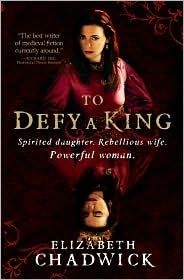
To Defy A King by Elizabeth Chadwick

Sunday, February 27, 2011

To Defy A King by Elizabeth Chadwick
Paperback, 560 pages
Medieval Historical Fiction
Published March 1st 2011 by Sourcebooks Landmark/May by Sphere
Review copy provided by Sourcebooks
The Burton Review Rating: 4.5 stars


Acquiring a novel by the now famous Elizabeth Chadwick is one of those win-win situations. You know you can't go wrong with Elizabeth Chadwick's writing, as she has gained fans around the world. I doubt anyone bothers reading this review because of the fact that almost everyone has the same opinions of her..Chadwick is an icon for the historical fiction community for her ability to create a believable and passionate story based around major events of the era. For me, she ranks up there with Sharon Kay Penman for medieval history.  Reading a new Chadwick novel is much like your favorite treat, you know you will be satisfied with the result. Last year I had loved her novels that focused on William Marshal, and here she comes again bringing us more William Marshal, perhaps the greatest knight to have ever lived... yet this time the story focuses on his daughter, Mahelt, also known as Maud or Matilda. I was eager to hate King John in Chadwick's The Scarlet Lion, and the feeling is back again with Mahelt's dealings with him as she watches her Marshal family become threatened by his various moods. He was murderous, treacherous, unwilling to cooperate with his barons; one shudders to think what his mama (Eleanor of Aquitaine) would have thought about his hateful and misguided actions.

Mahelt is not a prominent woman of historical importance, as opposed to the Eleanor of Aquitaine to whom her father had served, yet Chadwick weaves us a fascinating story of her as she reconstructs the historical events that occurred to her Marshal family and her marriage family. An interesting tidbit is that the sons of William Marshal had no children, yet it is through Mahelt's children that the Stuart Kings of Scotland claimed as part of their heritage. Through about three sentences mentioning Mahelt within medieval history which Chadwick found, she recreates with intricate details the life of Mahelt with a clarity that makes her readers feel like they are transported to that era. Chadwick portrays Mahelt as impetuous, stubborn, strong-willed, and totally likable.. Her marriage to Hugh Bigod comes at a time when the Marshals need a friend in high places, and the Bigods were a perfect fit, as were the new couple. Hugh seemed to enjoy Mahelt's willful character, and loved to be the one to tame her. I enjoyed the love story, the various characters such as her brothers, the historical details of King John vs. the world, and how the Marshals and the Bigods worked together, albeit tenuously.

Those readers who read Chadwick's The Time of Singing (UK) aka For The Kings Favor (USA), the story of Roger Bigod, will be reintroduced to Roger and Ida after their own love affair has settled. Ida now takes on Mahelt as her own daughter and helps her to adjust to the Bigod ways and tries to teach her to not step on gruff Roger's toes. As she proves her worth to the Bigods, her husband becomes smitten with her. Managing to please her father-in-law is another feat, but Mahelt does her best to heed to his will. King John creates havoc in the Marshals' world, and threatens the peace between the two families of Bigods and Marshals. King John loved to take hostages, such as Mahelt's brothers and others, some did not come out alive.

If there are any quibbles with the story of Mahelt, I can say that the author spoke of Mahelt's repulsion to sewing an awful lot, and her husband Hugh had many 'eloquent' looks, and the ending was a bit anti-climatic. But altogether the novel is one of family drama, loyalty, strife and historical details with a strong cast of characters that will please any history lover. I am waiting for some fabulous screenwriter/director combo to pick up on Chadwick's William Marshal novels and produce an epic movie for us that encompasses the stories of the Marshals and the Bigods before and during King John's rule. That would be a well-deserved feather in Chadwick's cap; she deserves all the accolades and praise as a queen of historical fiction. The spirit of the Marshals shine on her and through her worthy pen.