Follow Us @burtonreview

May 26, 2011

Armchair BEA~ Relationships

Thursday, May 26, 2011
Today at Armchair BEA, it is all about Relationships. The request is that we write about our experiences with building relationships online with other bloggers, authors, and publicists. I tend to go off on tangents, so bear with me.

I was one of those bloggers that participated in a survey that resulted in the Best Practices of Pitching Book Bloggers. This focused on relationships between Bloggers and Publicists and Authors. Don't you love it when you see "Dear Blogger"? When you get pitched several times from the same person about the same book, doesn't this get annoying?

When publicists contact us for review, and then we get asked for our webpage stats, does that annoy you? Doesn't it peeve you that the person has clearly not read your review policy? These and other pitching pitfalls are covered in this handy pdf, which is free to book bloggers.

It's a strange world out there for those authors who are new to self-promotion. They don't realize the netiquette that has developed along with the bookish blogosphere. If you know one of these newbies, point them to the Best Practices. Help build that relationship of trust between you and author instead of ignoring them. I know of several authors that remember me as one of their first bloggers that helped them through the book blog quagmire. It's a great feeling to be able to help them.

Over the past few years, I have seen the blogosphere quadruple in size. It normally starts as a reader who was looking for a particular genre of books, looking for ideas on what to buy next, and they stumble across a book blog. How neat, they think! A regular person talking about books! And then they discover the blogroll. And then they find more blogs in their preferred genre, as most blogs tend to link to blogs of the same interest. Then the reader realizes you can comment on all these posts too! Which brings reader to realize, how hard can it be to open a blogger account? And a blogger is born.

(That was my experience.) The relationships I developed in those early days of blogging still sit with me. I actually mentioned three of those historical fiction blogs that inspired me in yesterday's post. Two of these ladies I feel a kinship and bond with that I know will last a long time. If I don't get daily texts from one of them then I feel like my day is incomplete. And I know of other bloggers who get to meet up in NYC at conventions and more relationships are forged. It is quite powerful, actually, when I think of how much my life has changed since I became a book blogger. All these potential allies at my fingertips. And how amazing how many genres of book bloggers there are! General lit, feminism, young adult, graphic novel, romance, historical romance, classics, fiction...AMAZING!

It's been almost two and half years of reviewing books for me. It's a commitment. Sometimes it's a struggle as I look at the ARC Bookcase. You know, that ever present TBR pile that you should have conquered last year. So, it's a juggling act; especially for those of us who work full-time, have kids, a husband, animals and a house to take care of. Where does the blogging come in?

Better yet, where does the reading come in?

Somehow, I manage to do a little of everything. Which means I am not the best at anything. I can say I am a well-rounded individual, because I cannot spend too much on any one thing lest the next thing gets abandoned. I balance it out. Little by little. And with a little help from my friends. (Queue the music.) The support from the community of bloggers is there, if you ask for it. It's a big world out there. And book bloggers have really become a force to be reckoned with, even after all those professionally paid literary critics knocked us all down and said we were just a phase.

Go forth.. read.. review.. blog... communicate.. and kick butt. I am proud to be a book blogger. It has opened up my world to people and books I would never have otherwise come across. It's pretty awesome being a book blogger. We even have book blogger conventions! And if we can't go to the conventions, we can sit at our favorite chair for the Armchair BEA and still have a ton of fun! It's a great community, and I am happy to be here. Don't forget the amazing giveaways book bloggers host! (there's one going on right here!!) XXO


May 25, 2011

Armchair BEA-- Favorite Blogs!

Wednesday, May 25, 2011
It's Armchair BEA Time!! As part of the event, there is a fabulous giveaway going on right here for some fantastic historical fiction titles, as well as one you can pick out for yourself from the Book Depository! Check out the giveaway link here to get the scoop on the required scavenger hunt!!

Today, Armchair BEA is all about Working the Network!! Visit Armchair BEA to see all the different interviews of bloggers going on. I won't be one of them, I was in la-la land when the signup was taking place. So, for those of us who are not doing the interviews, we get to participate today by writing a post highlighting some of your favorite book blogs and bloggers - and I think I have done this before, a few times probably.. but since you may be new here (hello and welcome!!).. let me tell you who I like to visit. The following blogs have been around for a few years (and even longer than my blog which is about 2.5 years old), so they have some major staying power. And these are the ones who inspired me on my path as a book blogger as well.

Historical-Fiction.com - Arleigh's site is a clean, concise book review site that features..you guessed it.. historical fiction. Her reviews are intelligent and not at all flowery and over the top like some tend to be. She is to the point, and always manages to intrigue me with her reflections of her books, even if I read the same book. And of course this is my favorite genre, so this is a great place to be. Giveaways too!

Another favorite blog is..
Enchanted By Josephine: Celebrates Women in History - Lucy writes compelling and passionate reviews and always offers me something a little different than the current books that are being promo'ed around the blogosphere. Lucy also has an artsy blog that is beautiful to explore. Giveaways too!

Tanzanite's Castle Full of Books - Daphne's is a one-stop shop for upcoming releases and reviews of Historical Fiction. I love her Weekly wishlist feature which gives me the heads up on books I might need to make room for. She also does a monthly bookmark giveaway that I had to give up entering because I've been disappointed.. but these bookmarks are handmade and beautiful. She is in the process of moving so her posting may be a bit tilted in the near future, but this is another blog you need to follow if you enjoy historical fiction. Warning: if you do LOVE Historical Fiction, please don't be mad at me for directing you to the place that will cause your wishlists to explode!!


There goes my top three HF blogs!
And just to add something a little different just in case you're not all that into Historical Fiction (gasp!!), I also like to peruse the following blogs which offer intelligent content and interesting posts that aren't always about historical fiction:
Chick With Books
Jenny Loves to Read
Unabridged Chick

 Hope you find some great blogs during your Armchair BEA Blog hopping! Dang, how many times can I type historical fiction in one blog post?? Eight times. Seems like more.

May 24, 2011

Armchair BEA Event!!

Tuesday, May 24, 2011
So, as you know, I am forever continually stuck either in my work or home environment. It really isn't that bad.. but it means I don't get to go to the BEA in NYC. This week, there is the Armchair BEA event with meme style posts and giveaways for the poor folks like me. I don't know if I'll ever make it out of Texas again, but I sure wouldn't mind a mini-vacation.

Vegas calls..

AH!! Instead.. let's focus.

Yesterday, we announced the big event with three HF Blogs: Burton Book Review, Enchanted By Josephine, and Historical-Fiction.com. Be sure to enter by Thursday night!! BEA non-partygoers only!! =) It is a great opportunity to win some of the best titles of the past year thus far.

Speaking of.. Armchair BEA asks today (here comes the meme thing) What books have you read that are your Best of 2011?
So far on my "semi- finalist" list, for different entertainment value reasons, we have:

Elizabeth I: A Novel by Margaret George (click for my review)
Finding Emilie by Laurel Corona (click for my review)
The Queen of Last Hopes by Susan Higginbotham (click for my review)
The Tudor Secret: Book 1 Elizabeth I Spymaster by C.W. Gortner (click for my review)


These are listed in order of my most favorite of the year, yet I gave them all the best rating of 5 out of 5 stars. But, the year is not quite half over yet, so I cannot wait to see what will be next on my list! Will it be Karleen Koen? Elizabeth Chadwick? Sharon Kay Penman? Probably.


What do you think? Did you get a chance to read any of these picks? Would you agree?

May 23, 2011

GIVEAWAY!! Hey! We're Not Going to the BEA!!

Monday, May 23, 2011
And here is your chance to win the fabulous prize pack for the Nine Books we mentioned yesterday!
The BEA GIVEAWAY and Scavenger Hunt begins RIGHT NOW!


To see the details of the giveaway, please see yesterday's post.. which lists the eight advance copies of awesome historical fiction books PLUS the fact you will get to pick ANY book from The Book Depository..PLUS win a special gift from Tartx!

The blogs that are sponsoring this BEA Giveaway are:
Burton Book Review
Enchanted By Josephine
Historical-Fiction.com

Visit & enter at each of these blogs to increase your chances of winning. You can enter once here, or once there, or three times for all blogs.. but there will only be ONE Winner of the Nine Books.

 To enter here at Burton Book Review, go on a little scavenger hunt!

You must find and comment on two of the three blog posts that describe me meeting an author.

Comment on two out of those three posts that you are entering the BEA Giveaway, and also leave your email address.

That's all you've got to do!!

**Hints: Roses.. Elizabeth...**

Be aware there are actual posts about the specific event of meeting the author. There are 3 of the posts, one for each year. 2009, 2010, and 2011. Comment on 2 of these. Try the google search feature.

If you want to increase your chances.. go visit the other participating blogs! Good luck!
Giveaway ends Thursday night, open to the USA!

May 22, 2011

Hey! We're Not Going to the BEA!!

Sunday, May 22, 2011
Book Bloggers everywhere will be hearing about the BEA Event that is held in NYC this week. Just like last year, and next year, and the year after, I will not be going to the BEA. Odds are, you aren't either. Instead of crying in our beer, we are CELEBRATING!!!!


WOO HOO!
Why is this so awesome you ask? Because if you are not going to the BEA, you have a chance to win some fantastic awesome fabulous prizes courtesy of The Burton Book Review, Enchanted By Josephine, and Historical-Fiction.com!!! We three bloggers have come up with a super-duper fantabulous giveaway that you will be so happy that you stayed in your home with your own comfy bed with your happy family... because this is not one book, not two books, not three books, not four books, not five books, not six books, nope, not even just seven books, and not eight books either.. but we three are offering you some pretty fantastic books.. how about NINE BOOKS!!!! And nope, these titles are really nothing to sneeze at. These are ones that I have READ AND LOVED!!! It's just like you got to go to the BEA to snag some ARC's, but you don't have to stand in line.. and you don't have to pay to get to NYC to get them, and you are going to love these books!!

For instance, at The Burton Book Review, I am offering up for grabs four ARC's on Awesome Queens!!

 Mary Tudor: Princess, Bastard, Queen by Anna Whitelock
To Be Queen by Christy English
The White Queen by Philippa Gregory
The Captive Queen by Alison Weir
Click on the titles to read my reviews of these treasures. I have gently read two of these Advance Reader Copies, and the other two are extra copies that I read the original release copy instead of the ARC, so those will be new.

And Arleigh at Historical-Fiction.com is giving away these 4 ARC's:
King's Fool by Margaret Campbell Barnes
The Princess of Nowhere by Prince Lorenzo Borghese
The Confessions of Catherine de Medici by C.W. Gortner
Elizabeth, Captive Princess by Margaret Irwin
Click on the titles to read Arleigh's reviews of these ARC's.
And last but not least, Lucy at Enchanted By Josephine is giving away a book of the winner's choice from The Book Depository (up to $15 value!).

This super-duper giveaway of all of the above is going out to one very lucky winner in the USA. Just one!! To enter... you'll have to go on a mini scavenger hunt. You can enter at one blog, or all the blogs to increase your chances...

Stay tuned, because this event starts TOMORROW and you have to enter by Thursday night in order to get your chance at the super-duper grand prize! =)

See you tomorrow!

May 20, 2011

Hoboken's Holocaust: Hoboken, NJ Steamship Fire

Friday, May 20, 2011
One of those fabulous treats about reading a book is the knowledge you gain while reading it. Which is why I have enjoyed reading about the Tudors, the Plantagenets, and the medieval era: I am learning something. Every now and then, I want to take a ride on my wild side and read something different. So now I am reading Mothers and Daughters by Rae Meadows which is an interesting journey of three generations of women in the same family. As I was reading this, I was perturbed that I couldn't get a sense of time in the story for the grandmother, Violet. I like to know what era we are dealing with so that I could imagine the surroundings of the character.

And, finally, a gem was delivered seventy pages in. Violet meets up with a newsboy who is yelling out the headlines of the day. Newsboy immediately gets beaten up by some thug. Back up folks! Guess what the headline was? "326 people dead from NJ steamship fire!"

So I go immediately to the computer, and kiss my google homepage, and found this "Hoboken, NJ Dock Fire, Jul 1900" which was posted by Stu Beitler in 2007. How interesting the images he posted there and my further googling to learn all about these magnificent piers that replaced those lost in the fire.
 
The fire on Saturday, June 30, 1900 most likely started with a cotton bale located under Pier 3 at the Hudson River, and in less than 15 minutes it was a quarter of a mile long which destroyed millions of dollars worth of property including four steamship liners, barges, warehouses, railroad cars and four piers. The dry and windy weather helped propel the fire from the docks to the buildings to the ships. Roughly one million people observed it from various viewpoints, especially from within the tall buildings of Manhattan. They witnessed those that drowned that tried to escape the blazing steamships, as many of them simply could not swim. And, horrifically, some of the potential rescue tugboats decided to profit from the tragedy. They were lured by the thoughts of rewards from the sale of whiskey or cotton and chose to steal items instead of saving the people jumping from piers. Among the losses was the Campbell's Store building which was a $1.5 million dollar building.

Campbell's Store ruins
The SS Saale owned by the North German Lloyd Steamship Company had just loaded its passengers heading to Southhampton. Sadly, the coalburners which fueled the steamship were still cold, so they could not swiftly get out of the fire's path. Tugboats tried to pull each of the four ships away from the blazing docks. One ship escaped with minor damage. The Saale was not so lucky. Crew and passengers could not do anything but jump. Those below deck were trapped. In an attempt to put out the fire, the ship was soaked by the water hoses, so that those below deck could not get out. They were limited to tiny portholes. Later, regulations were finally made to make portholes large enough for escape.

According to one of the websites, there were 361 deaths (as opposed to the rumored 326) which included dock workers, crews, and these passengers. On the anniversary of the event, longshoremen are honored year after year, the crew being named in the papers at the time, and yet, the ninety passengers who died within the Saale have seemingly been eternally forgotten. There were about 250 total survivors of the four ships who were saved and taken to hospitals nearby. Captain C. August Johann Mirow remained with his ship, suffering the same fate as his passengers, and died a hero's death.


Captain C. August Johann Mirow, the popular captain of S.Saale 


Docks at Hoboken
 Interestingly, while perusing images and postcards sent during the aftermath, the postcards were being sent to Germany. Roughly twenty percent of the Hoboken residents were German, as was the captain of the Saale. For more accounts, please visit Maggie Blanck's site. There are some heart wrenching photos from the newspapers there as well. Maggie's grandmother was a survivor. There is a list of casualties here, with many unknown mentioned.

A bit of history I otherwise would never have discovered, if not for one line in a novel.

May 19, 2011

The Arrow Chest by Robert Parry

Thursday, May 19, 2011

THE ARROW CHEST by Robert Parry
Genre: Historical Fiction, Historical literary, Victorian Gothic
Createspace, January 2011
ISBN-13: 978-1452801148
342 pages, available in Paperback $11.95 and on Kindle
Author’s Website and Endymion at Night
Review copy provided by the author, Thank You!!
Burton Book Review Rating: Four Big Shiney Stars!


London, 1876. The painter Amos Roselli is in love with his life-long friend and model, the beautiful Daphne - and she with him - until one day she is discovered by another man, a powerful and wealthy industrialist. What will happen when Daphne realises she has sacrificed her happiness to a loveless marriage? What will happen when the artist realises he has lost his most cherished source of inspiration? And how will they negotiate the ever-increasing frequency of strange and bizarre events that seem to be driving them inexorably towards self-destruction. Here, amid the extravagant Neo-Gothic culture of Victorian England, the iconic poem ‘The Lady of Shalott’ blends with mysterious and ghostly glimpses of Tudor history. Romantic, atmospheric and deeply dark.


One of my favorite Tudor figures will always be Anne Boleyn. So when a Tudor fan has had her fill of the myriad of Tudor fiction available, what is the next best thing? The Arrow Chest by Robert Parry. Gothic suspense, macabre darkened hallways, bones in an arrow chest. This is how the novel opens up, as painter Roselli is called upon to sketch what is found in this arrow chest, most probably the remains of Anne Boleyn, beheaded queen of tyrant King Henry VIII.

The struggling painter did not particularly enjoy this task, as his favorite past time is painting his childhood friend Daphne. The story then goes on to focus on Amos and Daphne reconnecting during holidays with distinguished English folks, all the while Amos knows that something is just not right with Daphne's new life as a wife to the churlish Oliver Ramsey. As the story progresses, there are more than a few parallels to Anne Boleyn as we get into more of Daphne's character. It was played out in a subtle manner though, and only Tudor fans would catch these similarities. Until we got to Oliver Ramsey, who was portrayed just as maniacal as fat King Henry. I appreciated how the author recreated these details without pointing out the fact that Daphne was just like Anne Boleyn, especially since the main protagonist Amos was not an admitted Tudor connoisseur.

Parry's story is totally character driven from Daphne and Oliver to Amos' servants. Amos' maid, Beth, is a strong character as she willingly supports her artistic and eccentric employer even as she wonders if her life as a maid is to be her only destiny. And Amos is constantly seeking knowledge, of which the reader is privy to his musings, of inspirational and spiritual endeavors in many forms which rounded out the driving story of what would happen to Daphne. Would Daphne wind up with the same fate as Anne Boleyn? Would evil Oliver have her shut away in a loony bin because she couldn't provide an heir? Could Amos save her and allow himself the benefit of her love?

As a Tudor fanatic, I was impressed with the storyline and the way it was written by Robert Parry as he wove the history of the Tudors into the Victorian story of Amos the artist who loves a married woman, who was lucky enough to have the woman love him back. The Arrow Chest imbibes whimsical and mysterious plot lines with Robert Parry's distinctly descriptive prose. This is a love story channeling the spirit of Anne Boleyn and her tyrannical king, but it is also blended with witty scenes such as revengeful arm wrestling and ghostly tarot card reading scenes. The novel was so pleasurable that I was in no hurry to rush through to the story's end, perhaps because I feared Daphne would indeed suffer tragedy at the hands of her evil husband just as Anne Boleyn did.

As a self-published author, Robert Parry deserves to be picked up by a major publishing house (and acquire the benefit of a team of editors!). His writing and tone flowed flawlessly, aside from the editing issues. Those readers who are used to the punctuation type errors from advance reader copies like I am would not be disturbed by the errors that are in this copy, but the average reader may be distracted by them. I am editing to insert the fact that after I posted this review that I must have received an earlier edition of the book, as these errors were later corrected in newer copies. I cannot wait for the day when I can think of Robert Parry, "I knew him when...". Best of luck to him and I cannot wait to get around to reading his previous work, The Virgin and The Crab, as well as anything else he has in that creative mind of his.

May 17, 2011

Where have I BEEN?!

Tuesday, May 17, 2011
Where have I been?! So many things have been keeping me busy, chipping away at that golden free time, but I've been enjoying myself too. But, reading has taken the back burner. Expect more of this for the next 4 months as summer comes. I do not like to be on a review schedule during the summer so I will be a bit here and a bit there during the summer. But I do have plans of reading outside as the kids play, as long as I get all the weeding done etc. I do want to read more Plaidy and Heyer, they each have been pushed aside due to new releases, and I am going to move away from the advance reader copies ASAP. I am doing very well on the pile though.

For now, I am diligently working at catching a few pages a day of Robert Parry's The Arrow Chest.. but that's not adding up quickly. I hope to gather my wits and "git 'er done" as we Texans say! It's a good book too, but you know that already after I have seen it making the rounds on the blogosphere.

So what HAVE I been doing besides working and not reading? Meet Sweetie. An adorable little gal who is two and a half years old. She needs some TLC, and I am happy to give it.


Sweetie

I grew up owning cats, but soon enough they were replaced by human beings (my kids) and now it comes to the point where we can hopefully enjoy having a furball that doesn't live in a cage in my daughter's room(referencing her three dwarf hamsters).


So, when we moved to this house a year ago, we were pet-less. Now we have accumulated two fish tanks, the three hamsters, and Sweetie the Spoiled. Not to mention the Cardinal babies outside.

This little nest was discovered in an old flower pot that I was GOING to replace this spring. Mama Cardinal had other designs on it though. Poor thing sits on the hanging basket until we go outside and off she flies, and watches from the trees to make sure her babies are safe. She already lost one of three from flying out too fast. They should hatch soon.. we'll see!

And I drove a tractor this week. We had a wicked storm which downed lots of tree limbs so I was tractor duty while the husband was on chainsaw duty. Fun times. Sorry, no pics of that but I was tempted. =) One word of advice: Don't put an iPhone in the back of your pants and expect it to stay there when you're driving a tractor. I had a little dance going while I was fetching it out of my pant legs.

And we decided to take a break, and take the kiddos fishing out front, and I, of course, loved the happiness of the four year old when he caught fish all by himself!! Daddy was going back and forth between the two kids' poles so he didn't bother baiting his own pole. It was fast and furious.

And of course there was Mother's Day and a day of relaxation of me and the cat.. and now the cat loves to sleep in my bed on my legs. Of course I do my best not to disturb her. Why, I don't know.

I think it's the subliminal messaging she gives me during the day:


You will not budge when I am resting on you.

You will feed me tuna and turkey.
You will think it is cute that I knock all of your stuff down.
You will spend more money on my gourmet food than you spend on yourself.
You will not be annoyed that I have taken over your library.
You will learn to enjoy all this and more...
EDIT TO ADD!!
So silly! I forgot I wanted to mention that there will be a fun Scavenger Hunt Giveaway in honor of those who ARE NOT going to the BEA!!! It's going to be a blast.. and two other fantastic blogs will be joining in for the super duper giveaway.. three blogs contributing to one grand prize.. Stay tuned for the details this Sunday!!!!

May 9, 2011

Caleb's Crossing by Geraldine Brooks

Monday, May 09, 2011


Caleb's Crossing: A Novel by Geraldine Brooks
Hardcover: 320 pages
Publisher: Viking Adult (May 3, 2011)
ISBN-13: 978-0670021048
Review Copy provided by the publisher, thank you!
Burton Review Rating: 4.5 stars


After hearing much ado about Geraldine Brooks and her previous novels such as March, or Year of Wonders, I knew I could not pass this one up. I am not sure what I expected from this novel, but it wasn't exactly what I envisioned. Which is fantastic, because I think I enjoyed it that much more. Although the title and the premise follow along the path of Caleb, it was the fictional Bethia that was the narrator of the story and who sucked me in to this one. As Bethia is learning to grow into a respectable (and quiet) young woman in the late 1600's, she meets an Indian she calls Caleb. Her family is on a small island they called Great Harbor, now known as Martha's Vineyard, as her father taught and attempted to convert the heathenistic Wampanoag Indians to his religion of Calvinism.

We follow the path of these two young people and their families as their lives intersect and clash with their different values all the while Bethia tells us the story of her experiences with Caleb. She tells us of the school they go to in Cambridge, and of the prejudices that were abundant in those days as well as the smallest details that turn a simple story into one that is woven seamlessly into an evocative historical account. The prose of Geraldine Brooks was a bit to get used to at first, but as the character of Bethia warmed up to her story, I began to envision myself leafing through Bethia's written thoughts as if it were yesterday. Bethia was the star in this story, despite whatever intentions the author had to make it out to be Caleb.

Bethia was strong-willed, smart, and persevered through so much tragedy that I had to physically force myself to not cry out for her sorrow. And yet, with the grief painstakingly so well written, I was so eager to learn how Bethia would overcome this. She did overcome, and lost many, and Geraldine Brooks did Caleb's memory a great turn by giving him such a special friend as Bethia was shown to be. There were subtle facets and layers to the characters in Bethia's life, from her parents to her brother and of course, Caleb. The fated meeting of Bethia and Caleb set the two on a course that was dangerous to both of their positions in society, and I was intrigued to see how they would turn out.

Most of this marvelous story is fiction and dramatic license, yet the author drew on the bare minimum available regarding Caleb's real story to give us a piece of early Americana, offering us the struggles of the settlers versus those of the natives. And along the way, we are treated to a magnificently developing storyline of Bethia as we hope she finds true love and is able to display her keen intelligence even though she is a woman who was expected to tend to family matters quietly.

I loved this story both for Bethia's plights and for the historical significance of my country. I am always saddened how the Indians were treated during the colonization, yet Caleb's Crossing shows there were some who believed in their abilities and were willing to co-exist peacefully. This is a great read for those who enjoy reading coming of age type stories, and for those who would like to learn a bit more about America during the late 1600's. You will not forget the story of Bethia and Caleb.

May 3, 2011

The Sisters: The Saga of the Mitford Family

Tuesday, May 03, 2011


Even if the six daughters, born between 1904 and 1920, of the charming, eccentric David, Lord Redesdale, and his wife Sydney had been quite ordinary women, the span of their lives - encompassing the most traumatic century in Britain's history - and the status to which they were born, would have have made their story a fascinating one. But Nancy, Pamela, Diana, Unity, Decca and Debo, were, and are, far from ordinary.


The Mitfords' unconventional childhood and adolescence, growing up in a rambling country manor, deprived of formal education and at the mercy of their father's titanic rages and obsessions, has long been immortalised in Nancy's masterly comedies of aristocratic manners, The Pursuit of Love and Love in a Cold Climate. The girls' lives were the stuff of headlines. Nancy, the merciless tease turned brilliant, subversive novelist; Diana, the most beautiful woman of her generation, reviled for her abandonment of her gilded marriage and hated and imprisoned for her love of Oswald Mosely; rebellious Decca, who eloped at nineteen to the Spanish Civil War with Churchill's communist nephew and went on to become a ground-breaking civil rights campaigner; sweet Debo who became Duchess of Devonshire and chatelaine of Chatsworth; even feminine, domesticated Pamela, known as 'Woman', was enough of a Mitford to have John Betjman at her feet and her Raeburn stove painted blue to match her eyes. And at their dark heart, beloved but unstable Unity, in love with Hitler and obsessed with Nazism, who shot herself as war was declared.

In The Mitford Girls, Mary Lovell's extensive research traces the development of each of these remarkable women from the nursery to maturity, recording the terrible losses they suffered and the rifts that opened between them; uncovering often uncomfortable details of their politics and personalities and revealing the truth to be more complicated, but no less extraordinary than Nancy's fiction.

This is not a review, as I sadly have not read the book yet but it came via Paperbackswap and I cannot wait to get to it. I read Bess of Hardwick by the same author and I enjoyed it so much that Bess became a sort of heroine of mine. And what a life these Mitford sisters have had! Many of us may have heard of them, as I have, but I never truly knew who they were and what they stood for. And one of those sisters, Diana, was anti-semitic but don't let that horrific fact deter you from the total story. And will we ever have the total story? It seems like I will have a lot to learn about these girls who had style and presence, who had outspoken views on politics.

In my quest for google-like knowledge, I found this charming little spot on NY Times which dictates some letters between Nancy Mitford and a dear friend, Evelyn Waugh. How quaint! Yet, underneath the talk of books and general gossip, there were air raids nightly thanks to World War II. Jessica was a communist, Diana was a gorgeous woman who cheated and was universally disliked, even by her sisters, Debo was a Duchess of Devonshire, Pamela was another anti-semite, Nancy was a popular writer and Unity idolized Hitler.

Interestingly enough, Chatsworth House was the scene of my first blog headers. Chatsworth has origins with Bess of Hardwick, Pride and Prejudice, and Deborah (a Mitford girl) Duchess of Devonshire.

May 2, 2011

Queen By Right by Anne Easter Smith

Monday, May 02, 2011
Queen By Right: A Novel by Anne Easter Smith
Paperback: 528 pages
Publisher: Touchstone; Original edition (May 10, 2011)
ISBN-13: 978-1416550471
Review copy provided by the publisher, thank you!
The Burton Book Review Rating: 3 stars


In Cecily Neville, duchess of York and ancestor of every English monarch to the present day, she has found her most engrossing character yet. History remembers Cecily of York standing on the steps of the Market Cross at Ludlow, facing an attacking army while holding the hands of her two young sons. Queen by Right reveals how she came to step into her destiny, beginning with her marriage to Richard, duke of York, whom she meets when she is nine and he is thirteen. Raised together in her father’s household, they become a true love match and together face personal tragedies, pivotal events of history, and deadly political intrigue. All of England knows that Richard has a clear claim to the throne, and when King Henry VI becomes unfit to rule, Cecily must put aside her hopes and fears and help her husband decide what is right for their family and their country. Queen by Right marks Anne Easter Smith’s greatest achievement, a book that every fan of sweeping, exquisitely detailed historical fiction will devour.

Wars of the Roses followers recognize the Nevilles as having a strong family in the midst of the turmoil between the Yorks and the Lancastrians. Queen By Right gives us the story of Cecily Neville, daughter of Ralph Neville and Joan Beaufort, and shows us an indulging upbringing for her as well as an indulging marriage to Richard Plantagenet of York. A young Henry VI is on the throne, and Richard seems pleased to be this Lancastrian King's man even though he has his own strong claim to the throne that none can dispute.

Richard and Cecily are blessed with children, and history aficionados will know that these children include Edward IV and Richard III among the most notable. But who were their parents, and how did they get to the royal title? Focusing on Cecily, we become entwined with her character as the author dramatizes her young life as one long flashback to the elder Cecily ponders the very question of how this all came to be. The book opens to Cecily mourning the loss of her husband and favorite son Edmund in a battle against the Lancastrian king. But it wasn't always York versus Lancaster, so how did things get so convoluted as to battle for the throne?

The way Cecily's character is written makes her very likable from the beginning, but about halfway through we somehow lose touch with her. The character development of both Richard and Cecily left much to be desired as they seemed to stray from their once noble paths. Once Cecily becomes an adult, and a mother bent on favoritism, the story began to be more (ambiguously) focused on the politics of Lancaster versus York. Richard was away serving the king on various military appointments and never receiving payment for the money spent on the soldiers he lead, which bred discontent for years. And since this is where the focus lay, I was becoming impatient for the story to get on with it. Instead, we learn of Cecily's aversions to certain people such as Jacquetta, Duchess of Bedford, or fascination with others like Joan of Arc (the author mentions this was her poetic license). There is also quite a bit of sex but at least it didn't encompass the whole book, but the couple seemingly had eyes only for each other. A plus is that the rumored archer affair did not weave its fiction into this story. The author ascertains that the marriage between Richard and Cecily was a love match beginning in their childhood, though in her author's note she theorizes about the late development was in producing heirs.

An intriguing figure of this time is Jacquetta: Jacquetta of Luxembourg, Duchess of Bedford, or Jacquetta Woodville as she also may be known. She is mentioned several times in the story as she is a high ranking noble in her own right. Jacquetta is peeking out windows witnessing Cecily's actions, and she sends Cecily shivers down Cecily's spine many times. Jacquetta also befriends Margaret of Anjou and Cecily wonders how that could be. Was it Melusina at work? Jacquetta's first husband was related to the throne, but he passed away so Jacquetta made a scandalous love match with Richard Woodville. I mention all this because as a reader I paid attention to all the innuendo and the foreshadowing the author related when mentioning Elizabeth and her beautiful daughter, another Elizabeth, who ends up marrying Cecily's oldest son.

The first half of Cecily's life when she was growing up was an intriguing adventure. In the middle of the book we seemed to be merely skimming the surface, watching things happen from afar, and it just couldn't draw me into the story as it had at first. It was enjoyable reading about Cecily's early life, but as a mother and wife to Richard it became more about the antics of the children, and that of Richard himself. We all knew what happens to Richard in the end, because that is discussed within the first sentences of the novel. Getting to that point with that ill-fated battle became a long drawn out process of Richard whining about not getting paid for his services and Cecily praying to the Virgin Mary. The names of uncles and nobles who were in favor at court when Richard wasn't became a quagmire to sift through at first.

Still, I did gather a bit of information of Cecily and her life, and I was eager to learn a bit more about the struggle of why Richard Plantagenet did decide to grasp the throne for himself. He is not portrayed as an evil man as Lancastrian reads like to paint, as Richard states many times that he swears fealty to Henry VI as God's anointed. Keeping Richard out of the court's loop was also an annoying tactic of Henry VI, as he sent Richard off to Ireland and France to keep the peace but not supporting Richard monetarily to do so. Richard didn't like what was happening to the government at the hands of the king's advisers, and Richard had many who backed his own Yorkist claim to the throne after years of mismanagement. England seemed glorious under King Henry V, but his son was nothing like him. The loss of lands in acquiring the Queen for Henry was also an ill omen of things to come.

For those readers who really want to know more about the struggles of Cecily and Richard Plantagenet and those inherited by their children, the author does well to cover them in Queen By Right. Most Wars of the Roses fans don't get the 'before' scene of the Wakefield battle, as most know that it is Richard's son, Edward IV, who becomes successful for the Yorkist cause. It wasn't until the last quarter of the book that we are finally brought to this climax and started becoming intriguing again. Queen by Right delivers the details and the purported minds behind Richard and Cecily during the years before the famous battles. Anne Easter Smith is well known for her Yorkist novels, and for those readers who enjoyed her books like A Rose for The Crown or Daughter of York would enjoy Queen By Right as well for the lesser known story of Cecily's family and the separate factions of the land. I also must disclose that I have always seemed to lean towards the Lancastrian point of view rather than the Yorkist, and the novel is obviously Yorkist focused. Richard's wishy-washy character himself was portrayed in such a way that this reader wanted to slap him, as much as Cecily did when Richard put his family in such extreme danger. Also included with the book were a few helpful genealogy charts, map, bibliography and glossary.

Apr 27, 2011

In the Footsteps of Elizabeth I: Margaret George Does Dallas!!

Wednesday, April 27, 2011
Ok, well she DID do Dallas. I had the fabulous opportunity of meeting with Margaret George after her Arts  & Letters Live lecture that was held at the Dallas Museum in April for her Elizabeth I: A Novel tour. You can read my review of Elizabeth I here. I loved the book, and I was so thrilled that she was coming to Dallas. Margaret is very sweet in person, and her lecture spoke of her writing processes as well as her main character, Elizabeth. This couldn't come at a better time for me personally, as I feel I have now read so much on Elizabeth from non-fiction to fiction that I have a firm grasp of her character.

Yet, as Margaret suggested, there is always something intangible about Elizabeth, something vague that a reader always struggles to capture. But can a writer capture that? I believe Margaret rounded out Elizabeth's story very well for me, especially since the novel focused on the later years of her reign. Most of the reads I came across would focus on Elizabeth's lusty father and all of his wives, and if it focused on Elizabeth there were always scenes regarding Thomas Seymour or Robert Dudley. This time around, we had Dudley's step-son, the Earl of Essex as a leading character along with Lettice Knollys who is also a favorite Tudor of mine.
Margaret's lecture was titled "In the Footsteps on Queen Elizabeth I: Adventures In Research". She shared with us her experiences of becoming a writer, and her research tactics. She didn't have scholarly training as a writer, but she had great fortune to live in foreign places as a child due to father's career. Living in places like Israel, she felt very close to history as a child living next to places where historic events occurred. Her school in Jaffa, The Tabitha School, was run by strict Scottish missionaries, and was supposedly the place where St. Peter raised the little girl Tabitha who had died also known as Dorcas. She said she came from a bookish family, where her father had Ph.D. in 18th century literature and her mother taught high school English, and they all liked to read. She started writing as a hobby when she was young, from stories about horses to teenage stories as something that she did for her own pleasure. Only once she decided to write Henry VIII's story is when she became focused on her writing. Margaret wanted to introduce a young Henry to readers, when at that time there was not a lot about the young Henry as opposed to the monstrous traits that some writers focus on. Although Margaret has given us the story of Henry VIII, Mary Queen of Scots and now Elizabeth, we won't be seeing a book on Mary Tudor anytime soon from Margaret. She feels Mary's life is just so full of depressing events and it would just be sad to delve into her story.

Margaret went on to discuss her research process of reading books for research, making notations (in pencil!) in the margins, and then writing separate index cards categorized by topic. She showed us an example of an index card for her research on Elizabeth's progresses where Margaret made notes of what book referred to which progress in which year and what unique fact she learned that could be incorporated into her developing story. Elizabeth used these progresses as a bit of PR, and she liked to do them during the summer. It was very interesting to see how Margaret detailed out the pages numbers of which book to get herself organized to store facts such as how far a progress went and how long it was. Once upon a time, she used to write her huge books by hand! She also discussed the merits of first person versus third person point of views and how she used those in her books.

When Margaret is done with the actual researching of books and filling in index cards, she prefers to go to the actual places in her story. She visited the sites of Elizabeth just as she did for her previous books. At this point in the lecture, Margaret held up an Elizabeth tea cosy (audience laughed when Margaret was poking around under the tea cosy), showing how some of the royal figures in history get reduced to such a thing, but yet we still have no idea of who Elizabeth was. She really feels like the only way to get a glimpse of what's inside her character's heads is to be put in that setting of which they lived. Elizabeth left almost no private letters, and her poetry that is attributed to her cannot actually be authenticated.  We get nuances of Elizabeth through the contemporaries, but Elizabeth controlled her image as much as she could, as well as controlling what portraits were commissioned of her.

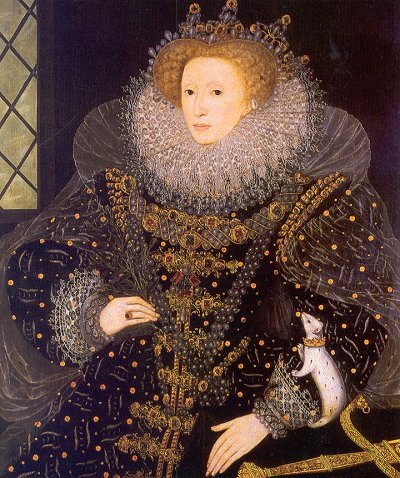
Margaret also discussed the outlook Elizabeth may have had on her beheaded mother, Anne Boleyn. She showed us a photo of the ring Elizabeth had commissioned which features both the portraits of Anne and Elizabeth. Even though she didn't attempt to rehabilitate Anne's reputation, she clearly had some bond or love of her mother simply for the fact that she wore that ring. And her father.. well, what do you do when your father beheads your mother? (More audience laughter). Elizabeth learned much from her father's reign, and she learned early on regarding the dangers of being close to the throne. Margaret shows us a portrait of Elizabeth when she was about thirteen years old, and how it was abundant with books. Did she want to portray the fact that she was a harmless bookworm, with no ambitions of the throne for herself, especially being third in line to the throne? It certainly was a clue that she was someone to not be tossed off as a silly girl. Further portraits of Elizabeth were always heavy with symbols, many dealing with purity and virginity.

The Ermine Portrait, 1585

An intriguing fact of Elizabeth is the fact that she was the Virgin Queen. Margaret discusses how Elizabeth wouldn't marry someone among her subjects (Dudley), which leads to rivalry and maybe riots. Yet, why didn't she want to marry to merge with another foreign power? She knew that to do so, England would be put at risk after her death. She also didn't want to share her status as Queen and give off any power to a consort which would breed discontent just as Philip of Spain did when he married Elizabeth's sister, Mary I. At the time, sexual relations conferred a legal status of a relationship, thus compromising her royal sovereignty. Margaret goes further into the speculations of the marriage negotiations, and the psychological reasons behind Elizabeth's refusal to marry. As popular story goes, King Henry IV of France reportedly said that Elizabeth's maidenhead was one of the three great mysteries of his day. He did not say what the other two were!  The audience loved this little story!

Margaret talked about the major crises or her reign: Mary Queen of Scots, the Armada, and the Earl of Essex. Elizabeth was not a vicious ruler like that of her father. She didn't want to execute Mary Queen of Scots or the Earl, but only did so when she had no other choice when they threatened Elizabeth's crown. An interesting fact Margaret offered is that Essex was the last nobleman to actually challenge the crown thereafter. Elizabeth's reign did not encompass many notable positive changes or events such as the Magna Carta, yet she goes down in history as a much loved monarch.

Elizabeth loved controlling her image such as her orchestration of the famous scene of addressing her troops wearing her virginal white dress as well as a breast plate. If anyone missed the speech she wrote, Elizabeth made sure it was copied and distributed throughout the land. Margaret shows us some portraits as well as her funeral effigy. The effigy was probably made from her death mask and the closest we would come to an accurate image of her, as she was not around to make sure it make her look young and vibrant.


After discussing Elizabeth, the audience was given the opportunity to ask questions of Margaret George. She told us that she is studying Nero for her next book, as she loves larger than life characters, and it takes about five years for her books to shape out. So we'll have quite a wait, yet that gives me the chance to read the rest of Margaret George's books. I think I will start with Mary Magdalene..


Margaret George signing, & me, being ecstatic.
Of course, after the lecture, I was able to get my books signed by Margaret George! I apologize for the yucky photos, iPhones are not the best cameras.. but here I am with Margaret George! She personalized and autographed the books, and she was such a pleasure to meet. She was extremely gracious, especially by scoring me those wonderful front row seats at the Dallas Museum. I was honored to be escorted by my mum who puts up with my bookish pursuits and gets to read my books sometimes before I do! Thank you to Margaret George for giving me memories to treasure for a lifetime!
Front row reserved seats for me! Squee!!

Apr 25, 2011

22 Britannia Road by Amanda Hodgkinson, a debut novel of postwar England

Monday, April 25, 2011

22 Britannia Road by Amanda Hodgkinson
Hardcover: 336 pages
Publisher: Penguin/Viking/Pamela Dorman Books (April 28, 2011)
ISBN-13: 978-0670022632
Review copy provided by the publisher, thank you!
The Burton Review Rating: Four Stars

A tour de force that echoes modern classics like Suite Francaise and The Postmistress.


"Housekeeper or housewife?" the soldier asks Silvana as she and eight- year-old Aurek board the ship that will take them from Poland to England at the end of World War II. There her husband, Janusz, is already waiting for them at the little house at 22 Britannia Road. But the war has changed them all so utterly that they'll barely recognize one another when they are reunited. "Survivor," she answers.

Silvana and Aurek spent the war hiding in the forests of Poland. Wild, almost feral Aurek doesn't know how to tie his own shoes or sleep in a bed. Janusz is an Englishman now-determined to forget Poland, forget his own ghosts from the way, and begin a new life as a proper English family. But for Silvana, who cannot escape the painful memory of a shattering wartime act, forgetting is not a possibility.


One of the most searing debuts to come along in years, 22 Britannia Road
Light, witty, fun and entertaining this is not. Provocative, emotive and despairing it is. 22 Britannia Road follows the effects of World War II on a wife and husband who were apart for six years because of the war. Silvana and Janusz were newlyweds in Poland when Janusz goes to become a soldier, and both meet up with horrific circumstances that are beyond their control. Silvana and her son Aurek survive in the forest, making acquaintances along the way, and Janusz travels throughout Europe during the war. The novel is more character driven and not focused on the details of the war, but it was a backdrop for why these two were put in the position they were in.

Finally the two reconnect and attempt to rebuild their lives in Ipswich, England. Silvana is no longer the svelte redhead, but a gray haired mess who lived on twigs and bugs for the last six years. Their son Aurek is not quite the social butterfly. The family needs to adjust to each other, to England, and communicate through the secrets that have built walls between them. The novel's title is the address of the house that Janusz buys in England, hoping for a renewed life as an English family with English roses. They have pleasant neighbors, Janusz works hard at his job, and there should be no issues. However, there are secrets that they both keep, and the boy himself creates a lot of havoc as he doesn't fit it in at school and is not used to sharing his mother with anyone. A fantastic feature to the present story is the back and forth between time lines of the struggles during the war from each of Janusz's and Silvana's viewpoints. Sometimes this switching back and forth becomes jarring, but the author did it so well and cohesively as the underlying tone of each chapter merged with the next, it was a seamless transition.

Not just about the themes of love, friendship and loyalty, it holds the darkness of secrets and the quiet tremors of fear of one's future. The novel, along with its beautiful cover, brings about a sense of hope along with the silent plea for normalcy after such a horrific time. They all just want to be a family, but there are more than just emotional scars that hinder their progress. Laced with suspense as we watch the characters develop and self-destruct, 22 Brittania Road is a formidable page-turning debut novel that tugs at your heartstrings.

The publisher is generously offering one lucky follower their own copy of 22 Britannia Road by Amanda Hodgkinson!
To enter, leave a comment with your email address.
For extra entries, (+1) tweet this post, or (+1) facebook the link.
Open to USA, ends May 2nd. Good luck!

Apr 17, 2011

Rivals in the Tudor Court by D.L. Bogdan

Sunday, April 17, 2011

Rivals in the Tudor Court (Tudor Court 2) by D.L. Bogdan
Kensington Paperback April 26, 2011
ISBN-13: 978-0758242006
Review copy provided by the author, thank you!
The Burton Review Rating: 4 stars
The death toll in Henry VIII's England can be counted in the thousands. No one was more aware of this than Thomas Howard, third duke of Norfolk. Relying on his indomitable force of will, cleverness, and sheer good fortune, Thomas Howard manages to be one of the king's only intimates to survive an unforgettable reign of terror. This impeccably researched companion piece to "Secrets of the Tudor Court" chronicles the ambitious duke's life, loves, and remarkable capacity to endure. Before he was the king's uncle, before he was his nieces' ultimate betrayer, Thomas Howard was a hostage at the court of Henry VII while his father was imprisoned in the dreaded Tower of London. There he would marry the queen's sister, his forever princess Anne Plantagenet. While he founded a dynasty, his career as soldier and sailor brought him acclaim and the trust of the Tudors. But when unspeakable tragedy robs him of family and fortune, Thomas must begin again. Abandoning notions of love, Thomas seeks out an advantageous match with the fiery Elizabeth Stafford, daughter of the duke of Buckingham. Clever, willful, and uncompromising in principle, the young duchess falls victim to a love she cannot deny. When Thomas takes on a mistress, the vulnerable Bess Holland, Duchess Elizabeth prepares to fight for all she holds dear. Only then does she learn she faces a force darker than anything she could ever have imagined, an obsessive love that neither she nor Bess can rival.
Thomas Howard, Duke of Norfolk, was a key player both behind the scenes and not-so-behind the scenes during Henry VIII's reign. Tudor fans recognize his name as the one responsible for putting his two nieces under the King's nose, ripe for the plucking. After Henry tired of mistresses Mary Boleyn and Bessie Blount, Thomas saw that Henry had eyes for Mary Boleyn's sister, Anne. And of course the rest is history.. Anne becomes queen, fails to give Henry the male heir and is summarily executed on trumped up charges of adultery. Another niece becomes available, Kitty Howard, who moves on become another Queen Catherine to King Henry.

But who was this man, the formidable Thomas Norfolk? Behind the political movements and shrewd judgement, he is one powerful noble who managed to escape the axe, although he came close and was saved by Henry's death alone. In D.L. Bogdan's previous book, Secrets of the Tudor Court, Thomas's daughter Mary Howard was the focus of the story but the story held frightening glimpses of Thomas himself, who is better known simply as Norfolk.

Why did he seem to be so cruel to his family? He beat his wife, his children, and paid his servants to do it some more. Not a very likable creature indeed, and D.L. Bogdan take us back to Thomas's beginning as a child struggling to make up for his short stature. His desire to be the best soldier earns him recognition, and Queen Catherine of Aragon favors him as well as King Henry does. He always wants more though, and he brings his family down whomever stands in his way.

Bogdan brings us the story of Thomas as he becomes more and more powerful, while also looking at the women in his life. We are treated to a never before seen look at Thomas Howard as he is undeniably happy with his first wife Anne Plantagenet until tragedy strikes again and again. The hardened man takes another wife with Elizabeth Stafford and we hope that perhaps he can come full circle, but he becomes more and more hateful, especially as he takes on a mistress, Bess Holland. We get the point of views of Thomas, his wife Elizabeth, and his mistress Bess, as they all struggle to maintain their wicked triangle of love and hate in Thomas's cruel world. With the intermingling of their lives, Bogdan presents a page turning story of loyalty, treachery and ambition giving us the Tudor flair that fans love.

Apr 13, 2011

Finding Emilie: Guest Post by Laurel Corona

Wednesday, April 13, 2011
The following is an article written by author Laurel Corona, who has recently published her newest novel, Finding Emilie (4/12/2011), which I consumed in a weekend and loved. Emilie sounds like such a magnificent lady-- charming, scientific, exhibitionist, Voltaire's lover...


Finding Emilie, by Laurel Corona
  
Emilie du Châtelet: Physicist and Party Girl

The Marquise du Chatelet’s parlor at her husband’s ancestral home in Cirey looked in many respects like that of any other aristocrat. The banquettes were plush, the chairs ornately carved, the tea and liqueurs beautifully arrayed in Sevres porcelain cups and tinted crystal glasses, the cakes and pastries freshly baked by the servants in the basement kitchen.

Only one thing was unique: in the center of the parlor, with chairs arrayed around, was a bathtub--a bathtub with Emilie in it, happily chatting away with her guests while clothed only in a diamond necklace and a silk chemise, transparent when wet. When her water cooled, a manservant recalled in his memoir, he would bring hot water and pour it between her parted knees, which revealed, in his words, “all her nature.”

Well, why not? Emilie du Chatelet was brilliant at everything, but was best at two things: knowing what she wanted, and getting it. From the age of ten she used her prodigious mathematical intelligence to beat adults at cards at the salons, then taught herself math and science from the books she bought with her winnings. As a young wife and mother, she occasionally cross-dressed to go to scientific meetings forbidden to women. When she wanted to learn to sing, she hired one of the voice teachers at the Comedie Italienne as her private tutor, learning whole lead soprano roles by heart even if she would never sing on stage.

Vivacious, irrepressible, charming, and daring, Emilie blazed through the world of Louis XV’s France, but her corset, wig, and panniers hid the most incredible thing about her: her first-rate scientific mind. Emilie du Chatelet used her privileged life to become one of the most important women of science not just in her era but in any. The fact that she is not a household word has far more to say about others than it does about her.

Believing until her thirties that her studies were just for curiosity and that she would never amount to anything as a scientist, she spent years helping her lover, Voltaire, conduct scientific experiments and write a work on Newton which he claimed as his own work. Voltaire had no particular aptitude for such work, but he wanted a seat in the French Academy of Science as a complement to his fame as France’s preeminent man of letters. He never got close. Today, it’s commonly believed that any solid, original thinking in Voltaire’s scientific works is attributable to Emilie.

A prize offered by the Academy of Sciences for the best paper on the nature of fire caused Emilie to break away scientifically from Voltaire and submit her own paper anonymously. She did not win, but received an honorable mention and the unusual acclaim of having her paper published alongside the winner--an indication that the only reason she had not won was because the Academy was unprepared to give the prize to a woman.

She continued a dual life of courtly obligations and scientific work into her early forties, when at the unheard-of age of forty-three, she got pregnant by a dashing young soldier- poet, with whom she had a passionate affair.

Premonitions of death in childbirth caused Emilie to work at a breakneck pace on her most important work, a translation of Newton’s Principia Mathematica. But hers was no mere translation. Few could comprehend Newton’s work, so Emilie rewrote it in French that scientists could understand. She also wrote commentaries to explain and expand upon Newton’s points, and in places where Newton had not presented adequate mathematical proof, Emilie figured out what those proofs would be and supplied the equations. Her translation of Newton’s Principia is still, 250 years later, the standard one used in France.

Unfortunately, Emilie’s premonitions turned out to be true. After an uneventful labor and delivery, she died six days after the birth of a daughter, Stanislas-Adelaide, probably of an embolism.

My novel is about finding Emilie on many levels. First, I “found” her and wanted to tell her story. But the book is less about her than her daughter. Effectively orphaned, Lili (as the girl is known) grows up, at least in my imagination, as unusual and independent of mind as the scandalous woman who bore her. Reaching her teens, Lili’s world closes around her as an impending loveless marriage threatens to take away her independence of spirit and dreams for her future. Believing that learning about her mother may point the way for her own life, she sets out to find Emilie for herself. Last, readers will find Emilie through the real-life scenes that appear between the chapters.


Welcome to 2011, Madame la Marquise! A more appreciative world awaits.
 
~~
Thanks to Laurel Corona for providing her with this piece! Her books can be found at online retailers at the following links:
Amazon
Barnes and Noble
Book Depository
Borders

The Burton Review posted a review of Finding Emilie here, and the author's previous release Penelope's Daughter here. Visit more articles by Laurel Corona here and here.

Apr 11, 2011

Finding Emilie by Laurel Corona

Monday, April 11, 2011


Paperback, Simon & Schuster, April 12, 2011
Review copy provided by the publisher, thank you!
The Burton Book Review Rating: 5 stars
Woman is born free, and everywhere she is in corsets. . . .


Lili du Chatelet yearns to know more about her mother, the brilliant French mathematician Emilie. But the shrouded details of Emilie's unconventional life—and her sudden death—are elusive. Caught between the confines of a convent upbringing and the intrigues of the Versailles court, Lili blossoms under the care of a Parisian salonniere as she absorbs the excitement of the Enlightenment, even as the scandalous shadow of her mother's past haunts her and puts her on her own path of self-discovery.

Laurel Corona's breathtaking new novel, set on the eve of the French Revolution, vividly illuminates the tensions of the times, and the dangerous dance between the need to conform and the desire to chart one's own destiny and journey of the heart.
Finding Emilie is about a young lady, Lili, looking to replace the void that was created within her as her mother, Emilie, passes away soon after Lili's birth and her father wants nothing to do with her. It starts off with a group of letters which sets the scene for how Lili came to be and for a bit of characterization of the supporting figures that are in her life.


Lili grows up with Delphine and is treated as part of the family under Madame de Bercy's roof, and where she is allowed to cultivate the spirit and inquisitive nature that she inherited from her scientific mother. The setting is the Enlightenment age of France, even though Voltaire's wild views were ridiculed by the French government. Lili and Delphine prosper under Delphine's mother's watchful but tolerant care, and eventually the two realize they must part and make good marriages. What comes next is the proverbial race to the finish line, hoping against hope the two girls will be able to make marriages that are both advantageous and amenable at the same time.

Much like the stories that I grew up with, there is a lot of wishful thinking and fairy-tale whimsies so typical in young girls, but I loved the way it was told. I was totally immersed in the character of Lili, even though it was told in third person I felt very close to her throughout Lili's story of self-discovery. Even though there were a lot of scientific references as Lili explored flowers under microscopes and thought about philosophies, I was not put off with the amount of it. I must have felt I was close to discovering the meaning of the universe right along with Lili.

A strong feature of the novel were the very characters, from the boys to the men and the servants in the many grand houses that were frequented. There were balls and the queen, and Voltaire, too. I loved feeling like I was whisked away to another time, as author Laurel Corona captured the essence of her characters with exquisite detail, making me feel like I had lost a friend when I concluded the novel. I was not disillusioned at all with the fact that the novel focused more on the character of Lili rather than solely on the historical details of the pre-revolutionary France, as I did not pick up the book with any expectations of the latter. By doing so, I was taken by surprise with how Laurel Corona's writing immediately drew me into her reimagined world of the daughter of Emilie du Châtelet and the story of her coming of age. Finding Emilie goes easily on my favorites of 2011 list.

Apr 8, 2011

Wickham's Diary by Amanda Grange

Friday, April 08, 2011
Wickham's Diary by Amanda Grange
Paperback: 208 pages
Publisher: Sourcebooks Landmark (April 1, 2011)
ISBN-13: 978-1402251863
Review copy provided by the publisher, thank you!
The Burton Review Rating: 4 stars
This prequel to Pride and Prejudice begins with George Wickham at age 12, handsome and charming but also acutely aware that his friend, Fitzwilliam Darcy, is rich, whilst he is poor. His mother encourages him to exercise his charm on the young Georgiana Darcy and Anne de Bourgh in the hopes of establishing a stable of wealthy social connections.


 At university, Darcy and Wickham grow apart. Wickham is always drinking and wenching, whilst Darcy, who apparently has everything, is looking for something he cannot find. Wickham runs through the money Darcy gives him and then takes up with the scandalous Belle, a woman after Wickham's own greedy, black heart.
Wickham's Diary is a quick little foray into Austen's famous Pride and Prejudice characters and is worth each little page it is printed on. It can be seen as a sort of prequel to P&P from wicked Wickham's point of view as he grows more and more jealous of the brooding Darcy. Everything Wickham has he owes to the elder Mr Darcy's generosity, yet George Wickham had known from the start that he must marry an heiress in order to sustain his lifestyle. Not a very likable character is he, but a fun read nonetheless as I really enjoyed the inside look at George as he schemes for his fortune.

The best part of the story was learning the background of George's parents, and I loved the character of his mother. Our favorite Darcy himself is not a big feature, as this novella is written diary style through Wickham and speaks of how annoyed Wickham is with Darcy. Georgiana is indeed a more featured character as George sets his sights on her, and I really wish the ending hadn't ended the way it had because it felt like there was a lot more to occur at that particular moment. There was no real sense of closure, but perhaps the author was leaving that up to Austen's Pride and Prejudice itself. Also, one must take into account this is a novella, and was seemingly meant as a explanatory precursor to the wild antics of George Wickham in Pride and Prejudice. I enjoyed it very much, and would have loved to have read it as an in depth novel. Grange's writing is perfect for evoking Austenesque tones and I look forward to perusing her backlist such as Mr. Darcy's Diary: A Novel, Captain Wentworth's Diary and Colonel Brandon's Diary.