Follow Us @burtonreview

Apr 12, 2010

Book Review: The Queen's Dollmaker by Christine Trent

Monday, April 12, 2010


The Queen's Dollmaker by Christine Trent
Paperback: 384 pages
Publisher: Kensington; Original edition (January 1, 2010)
ISBN-13: 978-0758238573
Review copy provided by the author, thank you!
The Burton Review Rating:Four big stars!


"On the brink of revolution, with a tide of hate turned against the decadent royal court, France is in turmoil - as is the life of one young woman forced to leave her beloved Paris. After a fire destroys her home and family, Claudette Laurent is struggling to survive in London. But one precious gift remains: her talent for creating exquisite dolls that Marie Antoinette, the Queen of France herself, cherishes. When the Queen requests a meeting, Claudette seizes the opportunity to promote her business, and to return home...Amid the violence and unrest, Claudette befriends the Queen, who bears no resemblance to the figurehead rapidly becoming the scapegoat of the Revolution. But when Claudette herself is lured into a web of deadly political intrigue, it becomes clear that friendship with France's most despised woman has grim consequences. Now, overshadowed by the spectre of Madame Guillotine, the Queen's dollmaker will face the ultimate test."

Christine Trent's debut novel offers promises of many more intriguing stories to come, and she has easily gained many fans, including myself, who have now read The Queen's Dollmaker. This novel features a young woman who faces severe and sudden hardships and is forced to leave her native France and sail to England. At the same time, the narration switches to Marie Antoinette who has troubles of her own, concerning her husband and the country she is the new Queen of.

This is my first official read of Marie Antoinette, fictional or otherwise, although I have collected quite a few books on the Queen I have not actually had one land in my review pile. I have acquired a keen sense of Marie Antoinette through Internet exploration, and I find the subject of the monarchy's dissolution and the fate of her children fascinating, and heart breaking. I have a beautiful pendant of a young Marie Antoinette that I wear occasionally as well. Congratulations to Christine Trent for being the first author to actually get me to sit down and read a full novel that includes Marie Antoinette, and my apologies for taking this long to get to it. I mention all this so my readers would know my position on this as my first fictional Marie Antoinette-related story.

The fact that Claudette Laurent gets on a ship to England because she can't find her betrothed in a day was grating on my sensibilities, but she was just sixteen and had nowhere to go, and probably felt at a loss as well as being in a state of shock after losing both of her parents tragically. She befriends a girl named Beatrice while on this same ship together and forms a lasting friendship with her and Beatrice's daughter. Intermittently, narration on Marie Antoinette's side of things slice in and out throughout this story, as Claudette's fortunes rise in England as she makes a life for herself, while back in France the Queen is suffering at the hands of the revolution. Sadly, through this telling, Queen Marie Antoinette seems oblivious to the dangers just as Claudette is naive in some aspects.

Claudette's character evolved as she grew up and matured so that she became very likable. Claudette's first job as a maid in a haughty woman's house was quite humorous and I enjoyed the mishaps that followed Claudette. Eventually she storms out of the house in a grand girl-power moment, and it was a highlight for her character. Operating her own doll shop without the aid of others was a great feat, especially since her superb workmanship became noticed by royalty. Soon, Queen Marie Antoinette ordered dolls from Claudette, which required her to return to France. She does find her betrothed Jean Phillippe again, and Claudette becomes torn between her two worlds of a prosperous England and the memories of her life in France. She has a magnificent new suitor in England, but will that be enough for Claudette?

And just when you think that's all there is to the story, Claudette soon finds herself trapped in France and without any justice. Will it be a Jean-Phillippe from her childhood to rescue her, or the gallant William from across the channel? Will both Queen Marie Antoinette and Claudette face the same tragic demise?

I found the storyline to be fast-paced and rhythmic enough to hold my interest while I was intrigued with the characters and their development. It was both plot and character driven, and I cared for the main characters throughout the story. It was not drowning in historical facts or details but was pleasing enough as the author deftly changed the setting from one country to the other. The scenic details impressed me more in the beginning of the novel in France when the descriptions of the fire occurred, and then later on when Claudette was in France again. The actual Marie Antoinette plot was not overly dramatic and was pretty much a side story inserted to help dramatize the political upheaval, allowing Claudette to steal the show as the story's heroine. Later on as Marie Antoinette's story comes to a conclusion, there was more of her featured. I found this to be a solid debut historical fiction novel for Christine Trent that I would not hesitate to recommend and I look forward to more from her.

Christine Trent's The Wax Apprentice is coming December 28, 2010 from Kensington Books and we are honored at the Historical Fiction Bloggers Round Table to feature the novel for our December event!

See another review at Historical-fiction.com or Historically Obsessed or Enchanted By Josephine

Apr 11, 2010

Mailbox Monday Time...

Sunday, April 11, 2010
Mailbox MondayMailbox Monday is a weekly meme that is hosted by Marcia at The Printed Page. We share what books that we found in our mailboxes last week. And I am adding what I purchased, swapped, etc.


Warning: Exploring Mailbox Mondays across the blogosphere will lead to toppling wishlists and to-be-read-piles! But it's the thrill of the chase that counts!

Books that found there way to my house included:
All The Queen's Players by Jane Feather (April 13, 2010
"At Queen Elizabeth’s palace, intrigue abounds. And when a naive girl with a gift for keen observation enters the court, she can hardly imagine the role she will play in bringing England—indeed, the whole of Europe—to the brink of war. Nor can she foresee her own journey to the brink of ecstasy and beyond. . . .
When she becomes a junior lady of Queen Elizabeth’s bedchamber, Rosamund is instructed by her cousin, the brilliant and devious secretary of state Sir Francis Walsingham, to record everything she observes. Her promised reward: a chance at a good marriage. But through her brother Thomas, Rosamund finds herself drawn to the forbidden, rough-and-tumble world of theatre, and to Thomas’s friend, the dramatic, impetuous playwright Christopher Marlowe. And then Rosamund meets Will Creighton—a persuasive courtier, poet, and would-be playwright who is the embodiment of an unsuitable match.

The unsanctioned relationship between Rosamund and Will draws the wrath of Elizabeth, who prides herself on being the Virgin Queen. Rosamund is sent in disgrace to a remote castle that holds Elizabeth’s cousin Mary Stuart, the imprisoned Queen of Scots. Here, Walsingham expects Rosamund to uncover proof of a plot against Elizabeth. But surely, nothing good can come of putting an artless girl in such close proximity to so many seductive players and deceptive games. Unless, of course, Rosamund can discover an affinity for passion and intrigue herself. . . . "

Girl in Translation by Jean Kwok (April 29, 2010)
"Introducing a fresh, exciting Chinese-American voice, an inspiring debut about an immigrant girl forced to choose between two worlds and two futures.

When Kimberly Chang and her mother emigrate from Hong Kong to Brooklyn squalor, she quickly begins a secret double life: exceptional schoolgirl during the day, Chinatown sweatshop worker in the evenings. Disguising the more difficult truths of her life-like the staggering degree of her poverty, the weight of her family's future resting on her shoulders, or her secret love for a factory boy who shares none of her talent or ambition-Kimberly learns to constantly translate not just her language but herself back and forth between the worlds she straddles.
Through Kimberly's story, author Jean Kwok, who also emigrated from Hong Kong as a young girl, brings to the page the lives of countless immigrants who are caught between the pressure to succeed in America, their duty to their family, and their own personal desires, exposing a world that we rarely hear about. Written in an indelible voice that dramatizes the tensions of an immigrant girl growing up between two cultures, surrounded by a language and world only half understood, Girl in Translation is an unforgettable and classic novel of an American immigrant-a moving tale of hardship and triumph, heartbreak and love, and all that gets lost in translation."

From paperbackswap:
Midsummer's Eve by Philippa Carr
The Mask of the Enchantress by Victoria Holt
The Song of Hannah by Eva Etzioni-Halevy

From a 'marvel'ous win at Wonders and Marvels:
Birthright by A. Roger Ekirch (Jan. 2010) For the first time, the remarkable story that inspired Robert Louis Stevenson’s Kidnapped.

No saga of personal hardship so captivated the British public in the eighteenth century as the turbulent life of James Annesley, the presumptive heir of five aristocratic titles and scion of the mighty house of Annesley. Kidnapped at twelve years of age by his uncle, “Jemmy” was shipped from Dublin to America in 1728 as an indentured servant. Only after twelve more years did he at last escape, returning to Ireland to bring his blood rival, the Earl of Anglesea, to justice in one of the epic trials of the century.


How, in an age without DNA laboratories or fingerprint records, could a prodigal hope to prove his identity, let alone his legitimacy, after such a long absence—all the while defying accusations of being a “pretender,” the bastard son of a maidservant, plus repeated attempts on his life? Bursting with an improbable cast of characters, from a brave Dublin butcher and a wily Scot to the king of England, Birthright evokes in vivid detail the volatile world of Georgian Ireland—complete with its violence, debauchery, ancient rituals, and tenacious loyalties.

Drawing on exhaustive research in Ireland, the United Kingdom, and America—including an intensive investigation of court transcripts and innumerable, rarely seen legal depositions—A. Roger Ekirch brilliantly resurrects an extraordinary family drama of betrayal and loss, but also resilience, survival, and redemption. 26 illustrations; 3 maps.


Bought at Half Price Books:


Jamaica Inn by Daphne Du Maurier (a 1936 copy from International Collectors Library)
"Jamaica Inn was an old hostelry hidden away in the lonely moors. Not far from the coast. Most of the coaches avoided it, for its name was evil and no man knew what mysteries its dark shutters hid. Yet it was to Jamaica Inn that Mary Yellan went, as a naïve young girl, when her mother died, to join her Aunt Patience and the strange, boisterous man her aunt had married—Joss Merlyn, landlord of the inn."


Royal Charles by Antonia Fraser

"The dust jacket reads: "'The Merry Monarch.' Rarely has such a popular catchphrase been so deceptive. England's spirited young prince, 'born the divided world to reconcile,' who spent his youth in penurious exile, a fugitive abroad; whose restoration to the throne after Cromwell's death, without a drop of blood shed in his cause, brought about a return to order and peace; whose reign gave its name to an entire society and culture; and whose private life involved almost countless mistresses and illegitimate children, was a man whose nature, honed by his years in exile, was at heart both melancholy and austere. The brilliant author of Queen Mary of Scots and Cromwell here brings her extraordinary powers of research and synthesis, her strong clear biographer's voice, to Charles II, his court and his time. In Antonia Fraser's vivid and balanced portrait, we see him whole for the first time. We see the happy secure childhood shattered when England plunged into civil war; his inability to rally the Royalist forces to save his father from being beheaded in 1649, making him Charles II, "The poor King, who has nothing of it but the name ... " We see his valiant march on England to regain the throne ("A braver Prince never lived") and his amazing escape after the defeat by Cromwell at Worcester; an escape to a penniless and homeless existence, forced even to leave his mother's court in France, Jiving amidst the tensions of conflicting 19yalties, potential betrayals, and the demands of counter-intelligence. We see the astonishing and dramatic Restoration of 1660, with not one single condition imposed or even suggested to him by Parliament, the flame of revolution had so blown itself out. And we see his reign itself, coloured by a series of dramatic events-the Great Plague, the Fire of London (during which Charles rode from place to place, directing the Guards fighting the fire), the Dutch Wars, the Popish Plot, the intrigues surrounding the legitimate succession, his tempestuous relationship to Parliament. Here is Charles II himself, witty and lovable, tenacious and generous, courageous and resilient, who surrounded himself with a "merry gang," irreverent young Wits who loved a high-spirited frolic and otherwise diverted themselves with poetry and plays and literature. Here is a man of great physical energy who quite simply loved women-and was enthusiastic, too, about tennis, swimming in the freezing waters of the Thames, fishing, walking with his beloved dogs. He was a passionate patron of racing (loved to dine with the jockeys) and of the theatre (many of his friends-and mistresses-were theatre people), an informed planner of parks and palaces, a man renowned for his friendliness, his care for the welfare of his people, the ease of access that he offered to his subjects. But behind the gay appearance was a melancholy that the delights of his court could not dislodge. He was ever watchful for a repetition of revolution, a man with an iron determination to preserve what was his, a man chiefly desirous of 'Peace and Quiet for his own Time.' In her biography-five years in work-Antonia Fraser offers important new judgments on central questions of the reign of Charles II: his relationships to his Catholic brother James and his illegitimate lightweight son Monmouth, and to his neglected but respected wife, Catherine; the complexities of his Secret Treaty of Dover with Louis XIV; his enigmatic religious beliefs and his deathbed acceptance of the Catholic communion. Her Royal Charles is a compelling and richly woven narrative that brings to life once again this fascinating king, who, as Bishop Burnet wrote, was 'the greatest instance in history of the various revolutions of which one man was capable.'"

And last but not least, for review:
Captive Queen: A Novel of Eleanor of Aquitaine by Alison Weir (July 13, 2010)
"For historical fiction readers, a tantalizing new novel from New York Times bestselling author Alison Weir about the passionate and notorious French queen, Eleanor of Aquitaine.

Renowned for her highly acclaimed and bestselling British histories, Alison Weir has in recent years made a major impact on the fiction scene with her novels about Queen Elizabeth and Lady Jane Grey. In this latest offering, she imagines the world of Eleanor of Aquitaine, the beautiful twelfth-century woman who was Queen of France until she abandoned her royal husband for the younger man who would become King of England. In a relationship based on lust and a mutual desire for great power, Henry II and Eleanor took over the English throne in 1154, thus beginning one of the most influential reigns and tumultuous royal marriages in all of history. In this novel, Weir uses her extensive knowledge to paint a most vivid portrait of this fascinating woman."

Apr 10, 2010

Camille Doncieux of Claude & Camille by Stephanie Cowell

Saturday, April 10, 2010
Claude and Camille by Stephanie Cowell
Please visit the main Round Table page to follow the links for all of the events we have for the HF Bloggers Round Table: Claude and Camille by Stephanie Cowell.

As portrayed in Stephanie Cowell's new novel, Camille Doncieux was Claude's first true love. She was a Parisian girl with a bright future, yet she set her stars on the then unsuccessful Claude Monet. They struggled together throughout her lifetime to make ends meet, and she seemingly did it with style and grace just to be by Claude's side, against both of their parent's wishes.

What is behind the story of Camille that Stephanie writes? She does write of Claude using Camille as a model, and Camille was the subject of many of Monet's paintings until her death. She exhibited such charm to Monet's friends that she was the subject of many of their paintings as well. There are several paintings mentioned specifically in Claude and Camille that Camille posed for:
Women in the Garden
Circa 1866
Women in the Garden was painted as Camille modeled as all the ladies for Monet in Sèvres, a commune in the southwestern suburbs of Paris, France. She posed for several of these styles of domestic scenes for Claude, and also donned a wig for the La Japonaise painting in 1876. This became the last large scale portrait he did of her.
La Japonaise
1876
Auguste Renoir was a fellow artist friend and he painted Camille as she read La Figaro on the couch in 1872, and a few years later he painted Camille with her son, Jean Monet. Throughout Stephanie Cowell's book, Monet seems to be struggling with the very idea of who was Camille?
Renoir
Claude Monet painted his muse many many times after meeting her in 1866. Camille Doncieux was his muse, and she only became his wife three years after giving birth to their first son. Camille was born in Lyon in 1847. Sadly though, she died not too long after their second son was born.


After a long illness, Camille died at age 32 in 1879, leaving Claude with their two sons. The painting above was done by Monet as soon as she died; he wanted to 'keep her'. The grief of losing a loved one, the utter feeling of being alone and incomplete without hope must have been pressing upon him as he painted this. He 'found himself desiring to reproduce the last image of she who would leave us forever.'

After Camille's death, Claude begged her elder sister to explain some of the momentos left behind. Camille was portrayed as flighty with her moods, but almost always supportive of Claude and his artistic

In Cowell's novel, Camille is portrayed as a woman with a vigor for life, and with a zest for creative outlets such as dramas, acting and writing. The death scene is not how she would have wanted to be remembered, and Monet may have known that which is why the death painting remained hidden for many years until his son allowed it to be viewed, years after Monet's own death. Monet kept a portrait of Camille in his bedroom for the rest of his life.
Camille probably would have liked to be remembered as the charming young woman who was Monet's muse. She enjoyed being known for the model as The Lady in the Green dress, the one in which Cowell tells us is the first painting Monet painted of her when she was nineteen years old. It was a large painting, and was accepted to the annual painting exhibition, the Salon, in Paris, the first major achievement for Monet. It would be fantastic if there were a wealth of information on her, but it seems she is to remain an enigma. I am eager to read a new book coming later this summer titled Monet and His Muse: Camille Monet in the Artist's Life, written by Mary Mathews Gedo.

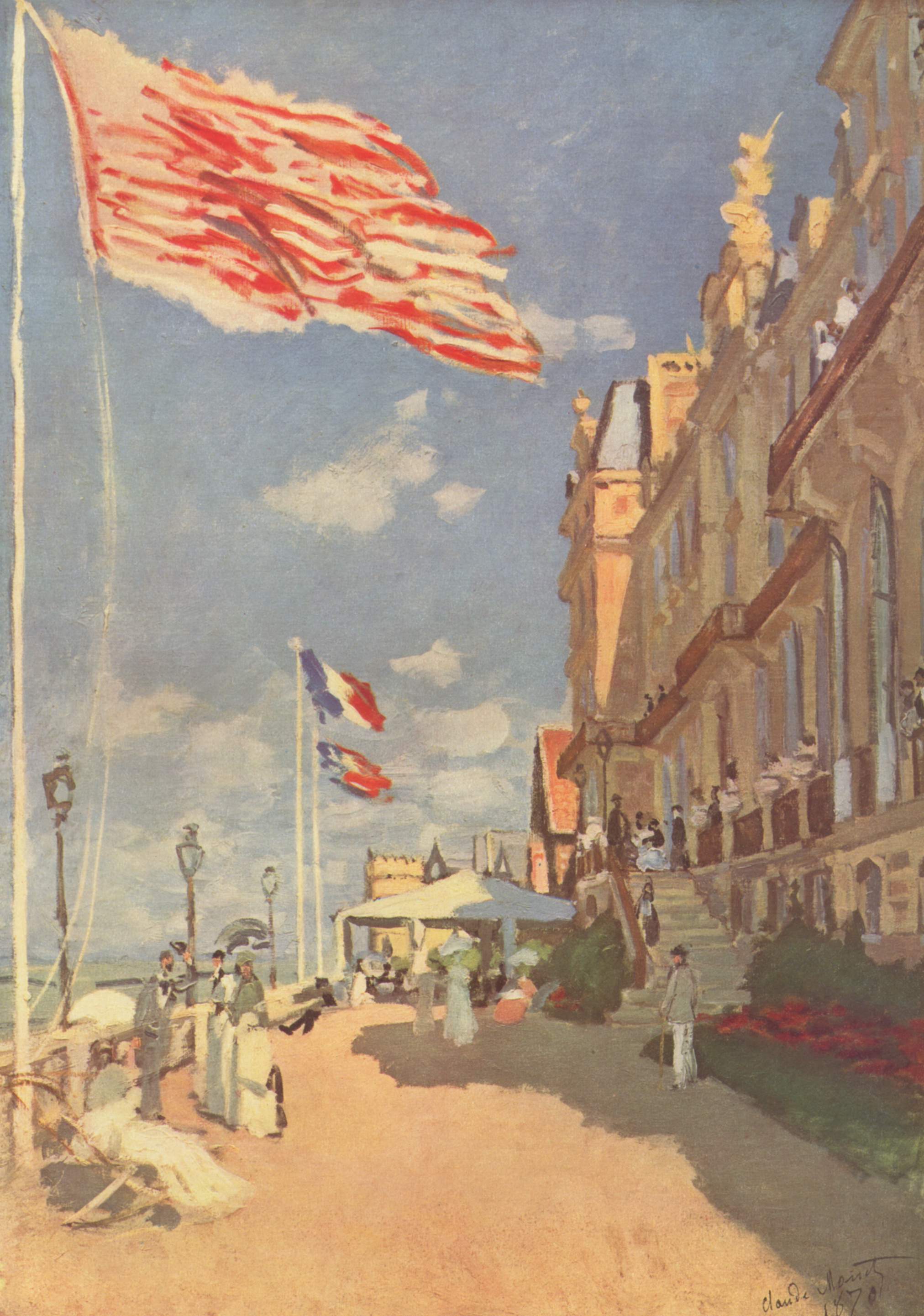
I visited the Dallas Museum of Art and was lucky that this month featured the exhibit of The Lens of Impressionism: Photography and Painting Along the Normandy Coast, 1850–1874. I was awe-inspired to be standing so close to paintings by Claude Monet, Eugène Boudin, Edouard Manet, Degas and many others. It was a fantastic visit. A few of Monet's earlier works were there. In one of the Monet's there was a portrayal of a hotel, which is where Camille and Claude honeymooned in 1870, Hotel des Roches Noires in Trouville. The painting depicts an American Flag, which is quite unusual in Monet's paintings. See the image here, the picture loader is not working at this moment. Is Camille in this painting? The couple vacationed with their friends as well during this honeymoon in Trouville.

In my search for Camille, I made the following compilation which includes both Monet and Renoir paintings of Camille. I included the Auguste Renoir paintings because the show a more vivid likeness of Camille, as opposed to Monet's own very impressionistic style, with the wider strokes of the brush.

Turn up your volume to hear the accompanying music, Violin Concerto in E minor - Andante:


Also on the Round Table Bloggers agenda for today are:
Arleigh's review of Claude and Camille at historical-fiction.com
A Guest Post featuring the author, Stephanie Cowell at Passages to the Past
See the main site for a full list of this week's events, which conclude April 13th. Be on the lookout for special Monet-themed giveaways around the blogs as well.

Apr 8, 2010

HF Bloggers Round Table Review: Claude & Camille by Stephanie Cowell and Giveaway!

Thursday, April 08, 2010
Claude and Camille by Stephanie Cowell

Claude and Camille by Stephanie Cowell
April 6, 2010 by Crown Publishing
Hardcover: 352 pages
Review copy provided by the publisher, thank you!
The Burton Review Rating:Four and a Half stars!


"Sometimes he dreamt he held her; that he would turn in bed and she would be there. But she was gone and he was old. Nearly seventy. Only cool paint met his fingers. “Ma très chère . . .” Darkness started to fall, dimming the paintings. He felt the crumpled letter in his pocket. “I loved you so,” he said. “I never would have had it turn out as it did. You were with all of us when we began, you gave us courage. These gardens at Giverny are for you but I’m old and you’re forever young and will never see them.."


In the mid-nineteenth century, a young man named Claude Monet decided that he would rather endure a difficult life painting landscapes than take over his father’s nautical supplies business in a French seaside town. Against his father’s will, and with nothing but a dream and an insatiable urge to create a new style of art that repudiated the Classical Realism of the time, he set off for Paris.


But once there he is confronted with obstacles: an art world that refused to validate his style, extreme poverty, and a war that led him away from his home and friends. But there were bright spots as well: his deep, enduring friendships with men named Renoir, Cézanne, Pissarro, Manet – a group that together would come to be known as the Impressionists, and that supported each other through the difficult years. But even more illuminating was his lifelong love, Camille Doncieux, a beautiful, upper-class Parisian girl who threw away her privileged life to be by the side of the defiant painter and embrace the lively Bohemian life of their time.

His muse, his best friend, his passionate lover, and the mother to his two children, Camille stayed with Monet—and believed in his work—even as they lived in wretched rooms, were sometimes kicked out of those, and often suffered the indignities of destitution. She comforted him during his frequent emotional torments, even when he would leave her for long periods to go off on his own to paint in the countryside.

But Camille had her own demons – secrets that Monet could never penetrate, including one that when eventually revealed would pain him so deeply that he would never fully recover from its impact. For though Camille never once stopped loving the painter with her entire being, she was not immune to the loneliness that often came with being his partner.

A vividly-rendered portrait of both the rise of Impressionism and of the artist at the center of the movement, Claude and Camille is above all a love story of the highest romantic order."

The inspiration and the beauty behind Claude Monet's paintings have intrigued me for years. His impressionism style is a fantastically elegant thing that is really indescribable. When the news came that Stephanie Cowell was writing a novel about Claude and his lover Camille, I was so eager to get my inartistic hands on it. I had visited a Monet exhibit once in Las Vegas, and I am so glad I had the opportunity to go, but I wish I had spent a longer time there. Like for a few days, perhaps. But, the line moves you along and boom your $30 bucks is spent. I just love his paintings and have for a long while, and I do own several Monet inspired gifty items.

Beginning to read the new novel, I had the feeling of something like a secret was about to be revealed to me. I could only hope that it lived up to my high expectations, and that of others. And it did. I found the read to be very pleasurable as Stephanie Cowell took me on a journey through Claude Monet's life and into his heart as he struggled to reach his muse's heart. Claude first saw Camille at a train station, and the visual of her plagued him for four years until he found her again, where she defied her family and stayed with Monet.

Instead of the somewhat tedious biography style type of read, the author Stephanie Cowell introduces Claude Monet to us as he is just another young man, struggling within the confines of a strict family. He is portrayed as the sensitive type, as expected, and is hurt badly when his mother dies. His father takes awhile to come around to Monet and to accept his artistic leanings, but we still empathize with the older man as he is forced to deal with the fact that his son will not be his father's shadow. We witness Monet's artistic tendencies as they develop and we meet some of the other famous painters of the time such as Renoir, Sisley and Bazille, and we learn of the struggles of the new impressionistic style of painting that he and his friends created.

We are weaved through the story of Claude as he struggles and continues to struggle, for in the whole book it seemed there was not an easy time for Claude Monet. He traveled from rented place to rented place, counting on hospitality and charity.. and through it all, his dearest inspiration Camille stuck by him. Camille, the girl who was bred to be a fine lady, fell in love with the artist and his dreams, and indulged Claude endlessly. The two seemed made for each other and it was a wonderful story to read about as I felt I had gotten to know part of the real Claude Monet through this writing of Stephanie Cowell.

I really enjoyed the small interludes the author inserted as the story briefly returned to Monet towards the end of his life, and I also felt that the author did well with the Parisian settings and the war. The imagery and visualization were quite palpable, as well as the utter despair and anguish that Monet repeatedly seemed to endure.

Since I shared a love for the French language with my father, I enjoyed the snippets of French words that the author inserted. Most of the time when the words were inserted, the English translation followed directly after, so that we would not be distracted at all with the french words there. Although, merde was said a lot, and the translation was not there, but that was the one cuss word that I had learned when I was twelve, with the admonition that it was used for luck for entertainers. I really enjoyed learning about the life of Claude and Camille, and I wish that it had been easier for him and his artistic friends.

I can totally see where readers of Claude and Camille who are current artists would relate to the same artistic frustrations of Monet, such as painting light and shadows and landscapes that shift with the wind. For that reason, I would not hesitate to recommend this artists as they can feel a kinship with a great painter of the past. I also recommend it for those who would enjoy an equally heart wrenching and heartwarming blend of romance, history and art.

Also today on the schedule is Author Guest Post w/sponsored giveaway at Historical-Fiction.com.
Visit my guest post featuring the author, Stephanie Cowell, here, and find your chance to win your own hardcover of Claude and Camille with that post, open to everyone in the USA.

And for now, we have a different type of giveaway! In honor of Claude Monet, I have a little Monet goodie pack to go out to one of my current followers, valued at over $15:

A brand new Monet bookmark featuring The Seine at Argenteuil
A brand new Monet Book of Postcards featuring 30 different images of his paintings
A brand new Monet magnet featuring his popular water lilies art
THIS IS NOT FOR THE BOOK!! This is for the items in the picture!

This is a special giveaway open to my current USA followers only.
Tell me you are a Current Follower, and leave your Email Address.

If you would like extra entries please do the following:
+2 Post the above Graphic on your blog's sidebar, linking to this post, leave the link to your blog.
+1 Tweet this post, using the Retweet button at the top of the Post, leave a link to your tweet.

Good luck!
Ends April 16th
Bookmark and Share

Apr 6, 2010

HF Bloggers Round Table: Author Stephanie Cowell: Growing up to write a novel about Claude Monet (Giveaway!)

Tuesday, April 06, 2010
Please welcome Stephanie Cowell, author of the new release of Claude and Camille, as it is the main attraction for this month's event at the Historical Fiction Bloggers Round Table.


Growing up to write a novel about Claude Monet
By Stephanie Cowell, author of Claude and Camille

When I look back, I feel I was destined to write a novel about a painter and somehow settled on Claude Monet.

Bazille Studio
My parents were both artists. I grew up in the shadow of the easel, passing carefully by marmalade jars full of delicate sable brushes for pen and ink drawing, sturdier bigger ones for oil paint and colored pencils. My parents took me to museums and art exhibitions since my earliest memories when about all I could see were grown-up people’s legs and the bottoms of picture frames. Artists came to the house. The air always smelled of oil paint. And I learned the stories of the struggles of the great painters.

My mother taught at the famous Art Students’ League in New York City and one evening she took me with her. I was less than five years old and, quickly bored with her class on fashion illustration, wandered off down the hall to peek into another classroom. I was amazed at what I saw and rushed back crying, “Mommy, there’s a woman on the model stand and she has no clothes on!”

At age fifteen or so my mother also drew me half nude and hung it in the hallway, to the great amusement of my boyfriends when they came to see me. (Claude Monet did not paint nudes!)

But painting was the center of my life and even now, when I am tired of words as novelists can sometimes be, I wander in the Metropolitan Museum which is near my house and feel so enriched.

I discovered when I was very young, however, that I had no talent to draw or paint. One day my father let me try at his easel. I expected to have his skill but discovered no skill at all. It was rather embarrassing because, as I became a teenager and a young woman, people always asked me, “Do you draw like your mother?”

But one thing my parents admired of me was my ability to tell stories. And at one of my early readings, a woman turned to my mother and asked, “Do you write like your daughter?” My mother shook her head with a smile. And I think from that I learned that we all feel and love a great deal but the gift with which we express it is different: cooking, writing, sewing, gardening.

I still have my mother’s marmalade jar but now it is filled with pens.


~
Thank you so much to Stephanie for sharing with your readers the story behind your inspiration of your latest novel, Claude and Camille, which is available for purchase today!

Please visit the Historical Fiction Bloggers Round Table main page for the Calendar of Events featuring Stephanie and her novel Claude and Camille!

Here at The Burton Review I will have a review, a post on Camille and a goodie giveaway! (*And it's not just a book!!)
There are many other fantastic giveaways that will be occurring, which are Monet related.. so be sure to keep up with the fantastic events this week! Today you will have two more chances for a giveaway at Passages to The Past and Historical-fiction.com

If you would like to win your very own copy of this book, then please comment on this post telling us anything you have previously learned about Monet or impressionism or if you have seen any of his paintings at a museum. LEAVE YOUR EMAIL ADDRESS.

For an extra point, tweet this post or facebook post it, leaving me a link to your status.
Book Giveaway open until April 16th to USA residents only.

Good Luck!

Bookmark and Share

Apr 5, 2010

Guest author Sarah A. Hoyt discusses Kathryn Howard, Fifth wife of Henry VIII

Monday, April 05, 2010
NO WILL BUT HIS by Sarah A. Hoyt (Berkley Trade Paperback Original; April 6, 2010; 978-0425232514; $14.00) is the fourth in a series of historical novels about the wives of Henry VIII, whose lives and loves shaped the future of all of Britain .

Her name was Kathryn Howard. Cousin to Anne Boleyn, the women for whom King Henry VIII changed the world, the orphaned Kathryn grew up a poor relation in a household where discipline was lax. Her youthful indiscretions would have hardly mattered if the eye of the aging King had not fallen on her. But she caught the King’s attention and, a Howard, Kathryn was ambitious. Henry called her his rose without a thorn, and she assumed the role of his untouched child bride, his adored fifth wife. Meanwhile, Kathryn relatives conspired to make sure that the truth was kept from the King.  Read an excerpt.


Mind Over Matter by Sarah A. Hoyt


The writing of No Other Will Than His – or at least the selling of it – started five years ago, when apropos very little in a phone call with my editor, Ginjer Buchanan, I found myself disputing her assertion that Kathryn Howard fifth wife of Henry VIII was “just a slut” and not very bright. Eventually my vigorous argument got me a contract to write a book about her.

I confess my opinion in the matter was probably colored by having attended an all girl highschool, where the class slut was also one of the brightest students. But there were more material considerations. Every other of Henry’s wives was smart and accomplished in her own way.

In fact, taken all in all, Katherine of Aragon, Anne Boleyn and Jane Seymour might have had little else in common, except that every contemporary agreed each one was a very intellectually accomplished female. Oh, certainly, Katherine of Aragon’s mind might run to theology, but she was also an able and accomplished agent for the relationship between England and Spain and proved more than a worthy adversary for Wolsey and all the King’s men. And Anne Boleyn was undisputedly quick of wit and as prompt with song and line as the king himself, if not more so. Jane Seymour, on the other hand, as quiet and domestic as she might have been – or at least played – was adept at managing the not inconsiderable royal household and was friends with her stepdaughter, Mary Tudor, who was herself no mean scholar.


With this in mind, and taking in account that part of what might have given Henry a disgust of Anne of Cleves was her inability to converse nimbly in English, it is highly unlikely he would have chosen a dumb bunny for his fifth wife.

I’m not disputing she was ignorant. The surviving letters from her are certainly pitiful. Though I will maintain you don’t have to be dumb to write near illegible letters. I have known mathematical and musical geniuses who could barely string two words together. On the other hand in her day book learning was not in general favored for women – beyond the king’s daughters themselves. Her step grandmother, too, the Dowager Duchess of Norfolk, might have kept Kathryn deliberately ignorant so as to make her more pliable – and that’s assuming that she was interested enough at first to care if she learned or not.

However, even though she might have been proffered to the king as a puppet, something in her must have caught the king enough to marry her. Her cousin, Mary Howard, was at one point encouraged to make the king her paramour, but never to attempt to marry him. Kathryn, however, who was still a child in our terms, was told to aspire for the top, and did manage it.
In the hothouse environment of the court, there must have been many other dainty, pretty young damsels to take the king’s eye. But only Kathryn captured him in matrimony and that bespeaks both courage and intelligence – the daring to aim for the top and to achieve it.

Yes, afterwards she might have miscalculated her position and ultimately paid for it with her life. Strategic brilliance cannot be expected of a girl who died before eighteen.

But in a brutal time, she used her looks AND her mind to best effect and even though her romantic heart might have preferred Thomas Culpepper embraced the challenge of capturing the crown.

Her fall was as fast and precipitous as her rise, but with all that, let’s pause for a moment and admire a young woman who has often been much maligned, but who in life must have been a creature of considerable courage, decision and intelligence.
 
NO WILL BUT HIS by Sarah A. Hoyt is available for purchase from Amazon, Ebay or your favorite booksellers.


Bookmark and Share

Apr 4, 2010

Mailbox Monday!

Sunday, April 04, 2010
Mailbox MondayMailbox Monday is a weekly meme that is hosted by Marcia at The Printed Page. We share what books that we found in our mailboxes last week. And I am adding what I purchased, swapped, etc.

HAPPY BIRTHDAY to my littlest one!

Warning: Exploring Mailbox Mondays across the blogosphere will lead to toppling wishlists and to-be-read-piles! But it's the thrill of the chase that counts!

Did you hear about my Tudor Mania Challenge coming up for May, June and July? Do you have Tudor Themed reads? I have these now to add to my list to read for the challenge:

HENRY VIII: The Tudor Tyrant by Richard Rex (Feb 2010)
"The future Henry VIII was born on 29 June 1491, the second son of Henry VII and Elizabeth of York. This talented, athletic and temperamental man might have proved something of a handful to his elder brother, Prince Arthur, the firstborn, had he survived to wear the crown. But Henry's life was changed forever when Arthur died in 1502 and the course of English history took a very unexpected turn... "

THE EARLY LOVES OF ANNE BOLEYN by Josephine Wilkinson (Feb. 2010)
"Anne Boleyn is perhaps the most engaging of Henry VIII's Queens. For her he would divorce his wife of some twenty years standing, he would take on the might of the Roman Church and the Holy Roman Empire; he would even alienate his own people in order to win her favor and, eventually, her hand.
But before Henry came into her life Anne Boleyn had already wandered down love's winding path. She had learned its twists and turns during her youth spent at the courts of the Low Countries and France, where she had been sent as a result of her scandalous behavior with her father's butler and chaplain. Here her education had been directed by two of the strongest women of the age - and one of the weakest.
Returning to England she was courted by three different suitors in three very different circumstances. The first was James Butler, with whom an arranged marriage was designed to settle a family dispute over the earldom of Ormond. Anne then captured the heart of Henry Percy, whose genuine love for her was reciprocated and would have lead to Anne becoming countess of Northumberland had the couple not been cruelly torn apart in the interests of politics and worldly ambition. Lastly, Thomas Wyatt, the dreamy young poet and ambassador who was captivated by Anne but who stepped aside when he saw that he had a rival: none other than the great King Henry VIII himself."

CATHERINE PARR by Elizabeth Norton (Feb. 2010)

"Wife, widow, mother, survivor, the story of the last queen of Henry VIII.

The sixth wife of Henry VIII was also the most married queen of England, outliving three husbands before finally marrying for love. Catherine Parr was enjoying her freedom after her first two arranged marriages when she caught the attention of the elderly Henry VIII. She was the most reluctant of all Henry's wives, offering to become his mistress rather than submit herself to the dangers of becoming Henry's queen. This only served to increase Henry's enthusiasm for the young widow and Catherine was forced to abandon her lover for the decrepit king.

Whilst Catherine was reluctant to be a queen she quickly made the role a success, providing Henry VIII with a domestic tranquillity that he had not known since the early days of his first marriage. For Henry, Catherine was a satisfactory choice but he never stopped considering a new marriage, to Catherine's terror. Catherine is remembered as the wife who survived but, without her strength of character it could have been very different. When informed that the king had ordered her arrest for heresy, she took decisive action, defusing the king's anger and once again becoming his 'own sweetheart'. It was a relief for Catherine when Henry finally died and she secretly married the man she had been forced to abandon for Henry, Thomas Seymour. During her retirement, Catherine's heart was broken by her discovery of a love affair between her stepdaughter, Princess Elizabeth, and her husband. She never recovered from the birth of her only child and, in her fever accused her husband of plotting her death.

Catherine Parr is often portrayed as a matronly and dutiful figure. Her life was indeed one of duty but, throughout, she attempted to escape her destiny and find happiness for herself. Ultimately, Catherine was betrayed and her great love affair with Thomas Seymour turned sour."

Purchased from Half Price Books (save me, I can't stop!):
The Gilded Chamber: A Novel of Queen Esther by Rebecca Kohn
(2004)
I love this cover, even though there is a boo*ie on there! I already had the Paperback so that's going to Paperbackswap.

"In the bestselling tradition of The Red Tent, a dazzling novel of the extraordinary biblical heroine who ascended to the position of queen and sacrificed love in exchange for the lives of her people.The story of Esther-whose mesmerizing beauty was matched only by her clear-eyed wisdom-has inspired women for centuries. Now her suspenseful tale comes to life through the eyes of a contemporary woman, debut novelist Rebecca Kohn. Capturing the passionate longings and political danger that have made Esther's legacy so timeless, The Gilded Chamber blends meticulous research with gripping storytelling to transport us to an ancient time in the far-flung Persian Empire.

Orphaned and terrified, Esther journeys across the River Tigris to start a new life with her cousin-a man well positioned in the court, and to whom she is betrothed. Her transformation from girl to woman unfolds against a lavish backdrop of the royal court and harem, rife with intrigue and daring alliances. Esther wins much of what she seeks: the heart of a king, and the deliverance of her people. But her rise to the role of queen is not without a price; she must turn her back on all that she ever wanted, and give her body to a man she can never love.
In a haunting, unflinching voice, The Gilded Chamber illuminates an epic dilemma between the yearnings of a woman's heart and the obligations imposed on her by fate. In Esther's case, choice makes history-and unforgettable reading."

The Unruly Queen: The Life of Queen Caroline by Flora Fraser (1996, biography)
"There are two types of British queens," says Columbia University historian David Cannadine.
"Those who hold the position strictly as wife of the king, and those (few) who have ruled as sovereign in absence of a male heir." Queen Caroline, who briefly held title when King George IV was crowned in 1820 is numbered among the former. Vulgar, selfish, and undisciplined, she fled from the husband she hated and became nearly as well known for her promiscuity as King George IV himself. Viewed by the public as a wronged woman, she survived George's attempts to dissolve the marriage, but opinion turned against her and she died in 1821."


King's Fool: A Notorious King, His Six Wives, and the One Man Who Knew All Their Secrets by Margaret Campbell Barnes (2009 reissue)
"First published in 1959 by world-renowned historical novelist Margaret Campbell Barnes, King's Fool is a remarkable insider tale of the intrigue, ruthlessness, and majesty of the Tudor court. When country lad Will Somers lands himself the plum position of jester to the mercurial King Henry VIII, he has no idea that he's just been handed a front-row seat to history.
With a seat near the throne and an ear to the floor, Somers witnesses firsthand the dizzying power struggles and sly scheming that marked the reign of the fiery Tudor king. Somers watches the rise and fall of some of the most enigmatic women in history, including the tragic Katherine of Aragon, the doomed Anne Boleyn, and Mary Tudor, who confided in the jester as she made the best of the fragile life of a princess whom everyone wished was a prince.
Based on the life of the real Will Somers, King's Fool is infused with Margaret Campbell Barnes' trademark rich detail and historical accuracy. This intimate peek into the royal chambers gives readers a unique view on one of the most tumultuous periods in English history."

Catherine de Medici: A Biography by Leonie Frieda (2003)
Color plate illustrations, map, genealogy chart, beautiful color flyleaf, London import, 440 pages.. woo hoo
"Catherine de Medici was half French, half Italian. Orphaned in infancy, she was the sole legitimate heiress to the Medici family fortune. Married at fourteen to the future Henri II of France, she was constantly humiliated by his influential mistress Diane de Poitiers. When her husband died as a result of a duelling accident in Paris - Leonie Frieda's magnificient, throat-grabbing opening chapter - Catherine was made queen regent during the short reign of her eldest son (married to Mary Queen of Scots and like many of her children he died young). When her second son became king she was the power behind the throne.
She nursed dynastic ambitions, but was continually drawn into political and religious intrigues between catholics and protestants that plagued France for much of the later part of her life.. It had always been said that she was implicated in the notorious Saint Barthlomew's Day Massacre, together with the king and her third son who succeeded to the throne in 1574, but was murdered - he was left standing with his assassin's dagger in one hand, and his own entrails in the other. Her political influence waned, but she survived long enough to ensure the succession of her son-in-law who had married her daughter Margaret.
Leonie Frieda has returned to original sources and re-read the thousands of letters left by Catherine. There has not been a biography in English of Catherine for many years and she believes that the time has come to show her - like Queen Elizabeth I of England - as one of the most influential women in sixteenth-century Europe."

The Rose of Martinique: A Life of Napoleon's Josephine by Andrea Stuart

"Josephine Bonaparte was one of the most remarkable women of the modern era. In this acclaimed biography, Andrea Stuart brings her so utterly to life that we finally understand why Napoleon's last word before dying was the name he had given her, Josephine. Using diaries and letters, Stuart expertly re-creates Josephine's whirlwind of a life that began with an isolated Caribbean childhood and led to a marriage that would usher her onto the world stage and crown her empress of France. Josephine's life gives us a picture of the terrible vicissitudes of the times. She managed to be in the forefront of every important episode of her era's turbulent history. After the Terror in Paris, the brilliant corrupt director Paul Barras rescued her from near-starvation. She epitomized post revolutionary Paris with its wild decadence and love of all things exotic, and it was there as its star that she first caught the eye of a young Corsican general who was to become the colossus of the age, Napoleon Bonaparte. A true partner to Napoleon, she was a political adviser, hostess par excellence, his confidante, and passionate lover."
The Rebels of Ireland (The Dublin Saga, #2) by Edward Rutherfurd

"The Princes of Ireland, the first volume of Edward Rutherfurd’s magisterial epic of Irish history, ended with the disastrous Irish revolt of 1534 and the disappearance of the sacred Staff of Saint Patrick. The Rebels of Ireland opens with an Ireland transformed; plantation, the final step in the centuries-long English conquest of Ireland, is the order of the day, and the subjugation of the native Irish Catholic population has begun in earnest.

Edward Rutherfurd brings history to life through the tales of families whose fates rise and fall in each generation: Brothers who must choose between fidelity to their ancient faith or the security of their families; a wife whose passion for a charismatic Irish chieftain threatens her comfortable marriage to a prosperous merchant; a young scholar whose secret rebel sympathies are put to the test; men who risk their lives and their children's fortunes in the tragic pursuit of freedom, and those determined to root them out forever. Rutherfurd spins the saga of Ireland's 400-year path to independence in all its drama, tragedy, and glory through the stories of people from all strata of society--Protestant and Catholic, rich and poor, conniving and heroic.

His richly detailed narrative brings to life watershed moments and events, from the time of plantation settlements to the "Flight of the Earls," when the native aristocracy fled the island, to Cromwell's suppression of the population and the imposition of the harsh anti-Catholic penal laws. He describes the hardships of ordinary people and the romantic, doomed attempt to overthrow the Protestant oppressors, which ended in defeat at the Battle of the Boyne in 1690, and the departure of the "Wild Geese." In vivid tones Rutherfurd re-creates Grattan's Parliament, Wolfe Tone's attempted French invasion of 1798, the tragic rising of Robert Emmet, the Catholic campaign of Daniel O'Connell, the catastrophic famine, the mass migration to America, and the glorious Irish Renaissance of Yeats and Joyce. And through the eyes of his characters, he captures the rise of Charles Stewart Parnell and the great Irish nationalists and the birth of an Ireland free of all ties to England. A tale of fierce battles, hot-blooded romances, and family and political intrigues, The Rebels of Ireland brings the story begun in The Princes of Ireland to a stunning conclusion." *I need to buy the first one.

And the next series that I'll need to buy the first one for is the Pendragon trilogy. Ms. Lucy, of Enchanted by Josephine is a doll and sent me books two and three by Helen Hollick:
Pendragon's Banner (Pendragon's Banner Trilogy, #2)

"At age twenty-four, King Arthur has the kingdom he fought so hard for and a new young family. But keeping the throne of Britain—and keeping his wife and three sons safe—proves far from easy. Two enemies in particular threaten everything that is dear to him: Winifred, Arthur's vindictive first wife, and Morgause, priestess of the Mother and malevolent Queen of the North. Both have royal ambitions of their own.
In this story of harsh battles, secret treasonous plots, and the life-threatening politics of early Britain's dark ages, author Helen Hollick boldly reintroduces King Arthur as you've never seen him before."

Shadow of the King (Pendragon's Banner Trilogy, #3)

"Arthur is dead. His widow, Gwenhwyfar, left at Caer Cadan with their small daughter, faces overthrow by the powerful council headed by Arthur's uncle. But, unknown to her, events in France and Germany mean that a far mightier battle lies ahead. This is the third volume in the "Pendragon's Banner" trilogy."


From Paperbackswap, thanks to Arleigh for some credits, I received:
Lament for a Lost Lover by Philippa Carr (Jean Plaidy) "Against the turbulent background of Cromwellian England is set this sweeping tale of a beautiful young woman's journey from innocence to wisdom--from love to treachery. Lovely, naive Arabella Tolworthy had grown accustomed to her innocence --until the colorful, charismatic actress, Harriet Main, and the dashing Edwin Eversleigh burst into her life. Arabella did pot know it, but these two people would completely change her future. Harriet, for one, would return again and again to influence Arabella's happiness. As for Edwin, Arabella fell deliriously in love with him and married him. But soon after the wedding she found herself a widow. She returned to England with the new reign of Charles II, ready to devote the rest of her life to memories of the past. Only one person had the power to free Arabella from her chaste and wealthy prison. That was Carleton Eversleigh, Edwin's cousin. But was he doing this for Arabella's sake... or his own?"

Knave of Hearts by Philippa Carr Daughters of England (book 10) Also known as Zipporah's Daughter: "Lottie, child of the passionate liaison between Zipporah and Gerard d' Aubigne, had loved her ambitious cousin Dickon since childhood. But when Dickon marries an heiress she is forced to begin a new life with her aristocratic father's family in France."

The Judas Kiss by Victoria Holt (Jean Plaidy) "Pippa Ewell had left behind the dark and forbidding Greystone Manor - also the memories of Conrad, the handsome stranger who had swept her breathlessly into his arms and heart. But Pippa returned to find the truth behind her sister's mysterious death. And suddenly the fairy-tale kindgom glittered with evil and danger..."

The Love Child by Philippa Carr "Priscilla Eversleigh hides Jocelyn Frinton, a young man who is traitor to the government and wanted alive. They fall in love, but tragically Jocelyn is captured and executed. Priscilla later finds out that she's going to have his baby.
Harriet Main, a friend of the family, helps to keep Priscilla's pregnancy a secret by inviting Priscilla on a vacation to Venice; upon arriving, Harriet will discover that she's "pregnant" and decide to have the child there.
In Venice, Priscilla is able to hide her pregnancy by wearing long, concealing clothes. She is pursued by Beaumont Granville, who tries to kidnap her. Fortunately, Harriet's son, Leigh, who was raised as Priscilla's brother, rescues her.
Priscilla gives birth to a lovely baby girl, whom everyone thinks is Harriet's, and they return home to England. But at home there is cival unrest among the royal family. King Charles has died, and two men are struggling for the throne. Priscilla's father gets involved, and is arrested. Desperate to save her father from execution, Priscilla agrees to let Beaumont help free her father, but for a price: Priscilla must spend the night with him."

Good King Harry by Denise Giardina (A Novel)
"Set against the sweeping backdrop of medieval England, Good King Harry brilliantly brings to life one of the most fascinating, conflicted monarchs in history: Henry V. Evoking the sights and sounds of fifteenth-century London, acclaimed author Denise Giardina artfully illuminates the double-edged sword of power--and the momentous events that unfold in the making of a king. . . .
A contemplative soul imbued with a compassion and mental agility beyond his years, young Harry, Prince of Wales--the future King Henry V--is marked early as the object of his father's scorn. For in the eyes of Lord Bolingbroke, his son is but a weak link in the House of Lancaster with a dangerous loyalty to the rebellious Welsh that must be broken.
As Harry reaches maturity, the battle within his heart grows fierce. Torn between the sensitivities of his soul and the uncompromising king he must become, Harry embarks on an odyssey rife with political agendas, sexual intrigue, and military combat--ultimately transforming into the accomplished monarch a volatile England so urgently demands."

A Secret Alchemy by Emma Darwin
something about 15th century, 21st century, royalty, England, history, historical fiction, Edward IV, Edward V, fiction, Henry VI, princes in the tower, Richard III, time-slip, Wars of the Roses, Elizabeth Woodville

In a fabulous win from Amy, the Still Too Cool for School Blogger over at Passages to The Past:
Drood by Dan Simmons .. I scoped out and entered for this book over at least 5 blogs, I wanted this win for my mama. Woo hoo! I also wanted Black Hills (I was born there!) but I was not that lucky.

"On June 9, 1865, while traveling by train to London with his secret mistress, 53-year-old Charles Dickens--at the height of his powers and popularity, the most famous and successful novelist in the world and perhaps in the history of the world--hurtled into a disaster that changed his life forever.
Did Dickens begin living a dark double life after the accident? Were his nightly forays into the worst slums of London and his deepening obsession with corpses, crypts, murder, opium dens, the use of lime pits to dissolve bodies, and a hidden subterranean London mere research . . . or something more terrifying?
Just as he did in The Terror, Dan Simmons draws impeccably from history to create a gloriously engaging and terrifying narrative. Based on the historical details of Charles Dickens's life and narrated by Wilkie Collins (Dickens's friend, frequent collaborator, and Salieri-style secret rival), DROOD explores the still-unsolved mysteries of the famous author's last years and may provide the key to Dickens's final, unfinished work: The Mystery of Edwin Drood. Chilling, haunting, and utterly original, DROOD is Dan Simmons at his powerful best."

Bookmark and Share

Apr 3, 2010

The Sunday Salon~ Happy Easter!!

Saturday, April 03, 2010
The Sunday Salon.com

Happy Sunday! Grab you mug of cocoa/coffee/tea, click the pics to visit other virtual reading rooms.. what are you reading this week??

And it's EASTER today... YAY I love Easter. Enjoyable bunny prep, lots of candy, ((CHOCOLATE!!)) and fun egg hunts!! It's of course only fun like that if you have little ones, and I qualify there, so I intend to enjoy it while I can.

And Easter will always be a little more fun because the day before Easter 2007 I brought my little boy home from the hospital for the first time. And I was a good mommy that year and made sure that I had everything prepped before I had the little brat. Yes he is a brat now. He was a brat in my belly too, come to think of it. Oh well. Someday he'll get his comeuppance.

This week I did not get a lot of reading done; I had finished Christine Trent's The Queen's Dollmaker, and began The Lost Summer of Louisa May Alcott by Kelly O'Connor McNees. I love Louisa May Alcott and this story begins as she is a young woman struggling with the constraints of family obligations over her own ambitions.

On Monday I reviewed Within the Hollow Crown by Margaret Campbell Barnes which I recommend for those interested in the period relating to Richard II. I also reviewed The Founding, book one of the Morland Dynasty, by Cynthia Harrod-Eagles.

The Historical Tapestry blog has a great list of new historical fiction posted this week for the month of April. A great month for readers, it is going to take me a year to keep up with April!


Coming up this week, the Historical Fiction Round Table Bloggers will bring you all set of different posts surrounding the release of Stephanie Cowell's Claude and Camille!! Be prepared to to be inspired, as I have been. I even felt much more in tune to the museum visit we had on Friday, and I was incredibly touched as I was inches away from Monet's paintings. Amazing stuff.

 
Don't forget to schedule some Tudor-themed reads for May, June and July, as I will be hosting the Tudor Mania Challenge here at The Burton Review! There is a post here with all of the details and see how you can participate in this challenge. I want to use this post as a chance for everyone to learn about new Tudor-themed reads, both non-fiction and fiction. I look forward to the challenge and I hope to see you there. There is a button on the top left sidebar that you can snag for your sidebar as well, I would appreciate you spreadinng the word for the challenge!

Happy Easter to everyone who celebrates! I am hoping the lovely Dallas weather of late keeps itself sunny and shiny for the eggs hunts! Enjoy!

PS Last week I had a newsletter contest for two different books: My hubby picked numbers and the winners are:
Mystica gets Fireworks over Toccoa
Michelle Miller gets What Would Jane Austen Do?

Congrats! I'll email you shortly!


Bookmark and Share

Apr 2, 2010

Book Review: The Founding by Cynthia Harrod-Eagles

Friday, April 02, 2010

The Founding by Cynthia Harrod-Eagles (Book #1 Morland Dynasty)
Product ISBN: 9781402238154
Price: $14.99
Sourcebooks Publication Date: April 2010
Originally published by Sphere 1980
Review copy provided by Sourcebooks
The Burton Review Rating:Three and a Half Stars

Seeking power and prestige, grim, ambitious Yorkshireman Edward Morland arranges a marriage between his meek son Robert and spirited Eleanor, young ward of the influential Beaufort family. Eleanor is appalled at being forced to marry a mere “sheep farmer”; she is, after all, secretly in love with Richard, Duke of York.


Yet from this apparently ill-matched union, Robert and Eleanor form a surprising connection that soon will be tested by a bloody civil war that divides families, sets neighbor against neighbor, and brings tragedy close to home.
The Founding is a novel that Cynthia Harrod-Eagles wrote in 1980, originally intended to be a twelve volume series written by two writers. Which would have already been a large task, but somehow it turned into one writer penning all thirty-four novels (the thirty-fourth will be published in November 2010 by Sphere). Sourcebooks is now reissuing some of the earlier novels, such as this first book that starts in 1434 in England. The fictional Morland Dynasty is now the longest-running historical family saga ever, which follows the Morlands for over 500 years of their history.

Eleanor Courteney was a ward of a nobleman and fancied herself married to a nobleman one day. But she was with no dowry, so she was going to have to accept a lower standard and was forced to do so when she married into the Morland dynasty. The Morlands were not of the same group that Eleanor would have preferred, but they were known for their riches as they were successful sheep farmers. Eleanor was portrayed as haughty and materialistic, as she not so quietly put up with her father-in-law until he passed, and when he did she set to work on her weaker-minded husband as to how to raise a gentleman's household. I did not feel very sorry for Eleanor, she was a bit sarcastic and snide, and even the word sarcastic was used a bit too much throughout the novel.

The story is very much a family saga epic style that I truly enjoy, and the one setback for me was Eleanor. As the main protagonist, I did not empathize with her much, as she continually disappointed me until the very end. Her children came and went and I did not feel as close to them as I wanted to either. I could not get my head totally absorbed in the characters, perhaps because there were so many. Yet, the whole package of the story set against the backdrop of the Wars of the Roses was very cleverly done and is what propelled me through. The Wars of the Roses is one of my most favorite periods to read about, and I always enjoy reading another view point.

Of course, this is truly fictional with the fictional Morlands being inserted at opportune times to be able to tell what is going on behind closed political doors, and of course Eleanor was very close to certain members, such as Richard Plantagenet, father to King Edward IV, and later her son/grandson/(I lost track) was also in service to the next king Richard. I was most happy when the history part came in to being within the writing, and less so when it was all about Eleanor. (Think "Marsha, Marsha, Marsha!!" but replace that with Eleanor). Eleanor is strongly Yorkist, therefore the book is very pro-Ricardian and prejudiced against the Lancastrians. While I try not to stand too strongly in one camp, I do have respect for the Tudors, who are Lancastrian. There are mentions of the "vain-glorious and weak-headed Buckingham" and Henry Tidr (aka Henry VII) and the scoffing at Tidr wanting to change the spelling of his name to Tudor. Another favorite historical topic of mine deals with the missing princes in the tower, which was totally not accurately portrayed; along with many of the other historical details, but this issue could easily be overlooked by those who are simply enjoying the story of a family's journey.

Along with Eleanor there are many children. There were births of those children, marriages, births of children to those children, and deaths. There had to be a few left standing though, in order for the next 33 books to be able to be called the Morland Dynasty. There are family trees in the beginning of each book that pertain to that particular branch and book, and you can also find them on the author's website. I was having trouble keeping up with the kids and the kids of the kids and who belonged to who which is why the family trees come in handy, and I had to consult them often. I hated noticing the date of death for each person because then I knew what was going to happen. To top all that off, one kid was called either Thom or Thorn depending on what time of the day it was and I kept re-reading it to see if I had misread it. Turns out after I wrote this review that the name was supposed to be Thom but the ARC I had was wrong.

But through it all, although this is not a heart wrenching, tear jerking, literary masterpiece, I still enjoyed the story. I think if Eleanor was a bit more likable it would have reflected on the rest of the book for me as well. I have not given up though, as I have Book #2: The Dark Rose waiting in the wings for June 2010. The next one deals with Henry VIII's times and I look forward to the the point of view of that time period, and sincerely hope that the protagonist there is someone after my own heart. I think moving away from the matriarch Eleanor and from my favorite Wars of the Roses topic, there is still hope for me with the series since I did enjoy the writing style very much and I am a fan of historical sagas. I have seen many many many many much more gushing positive reviews than my opinion here (I spelled out all the knit-picky things here which I normally don't do) so I think I am the minority of those who did not absolutely adore the book. But, it must be said the ending did end well enough that I was deeply touched and the ending helped redeem the entirety of the novel for me. The novel did its job of keeping me entertained throughout, and I would recommend this for those who enjoy family sagas set against a historical theme.

Coincidentally, official publication dates that coincide with the April 1, 2010 reissue date for book #1 include:
The Fallen Kings (Book 32 Morland Dynasty) by Cynthia Harrod-Eagles (Hardcover - Apr. 1, 2010)
The Foreign Field (Book 31 Morland Dynasty) by Cynthia Harrod-Eagles (Paperback - Apr. 1, 2010)

Sphere is a UK publisher and these books will be available in the US and UK following the links.

See another review at Passages to the Past

Bookmark and Share